Fic: That Deep Shiver of Gladness (Narnia/DCU, various pairings)

Author’s Note: No one belongs to me but Hope, and I only have joint custody of her. All characters you recognize belong either to the estate of CS Lewis or to DC Comics. The rest are on loan from DebC and Christina A. Also, this is slightly AU because when I wrote it, I forgot that Professor Kirke’s house had been torn down by the time of The Last Battle. So imagine instead that when Alfred learned it was going to be torn down, he persuaded Bruce to buy it and give it back to the Professor. *g*


Part I

“Are you sure it’ll be all right?” Hope asked anxiously as she and Peter made their way down the corridor of the train to the compartment they’d reserved. “I mean, I know your Mom and Dad did invite us, but that’s still an awful lot of people: Dad, Mom, me, not to mention Grace and Bruce–”

Peter laughed, an affectionate smile crinkling the corners of his beautiful blue eyes. “Hope, you mustn’t worry so. It will be fine, I promise. And you’re beginning to sound like Su besides.”

Hope resisted the temptation to make a face at him and settled for scowling fondly instead. “Now that is entirely unfair, both to me and to your sister. It’s just that I’ve seen your parents’ house in Finchley and it’s lovely but it is rather small…”

“But we’re not going to Finchley,” Peter pointed out with a twinkle in his eyes. “Or haven’t you noticed yet that this train isn’t bound for London?”

Hope blushed. Truthfully she’d been so content just to be spending Christmas with both Peter and her family that she’d hardly paid any mind to their tickets. “Oh…then where are we going?”

“An old friend of ours, Professor Kirke, has a grand old house in the country,” Peter revealed. “He invited us all for the holidays and when I told him about you, insisted that we invite your family as well.

“There’ll be heaps of people there–not just Mum and Dad, Susan, Edmund and Lucy but also our cousin, Eustace, and his friend Jill Pole, and of course Miss Polly.” She could hear the excitement in his voice. “It should be a right jolly time, provided Susan is all right about the house.”

“Who’s Miss Polly?” Hope asked next, feeling a little overwhelmed at the great catalogue of people. “And why wouldn’t Susan be all right?”

“It’s a long story, which I promise I’ll tell you one day,” he answered, giving her a brief kiss. “For now, suffice it to say something happened there, something wonderful that changed all our lives–mine, Susan’s, Edmund’s and Lucy’s–and I don’t know why but for some reason Su has chosen to act as though it never happened.”

A shadow crossed his eyes then and Hope felt a pang of sympathy: worry for a sibling was something she understood all too well. She and Grace had given each other cause to worry on more than one occasion, most recently when Grace and Bruce had parted ways for some reason Hope still didn’t understand. They’d reunited about six months ago and were now planning their wedding, but a small part of Hope still resented the man for the pain he’d caused her sister, even if flying himself, Grace, and their parents across the Atlantic to join them for Christmas did help. But then, what was the use of being a millionaire if you couldn’t give lavish gifts to the woman you loved and her family?

“Does this have anything to do with Susan always trying to act as though she’s everyone’s mother?” she asked gently, her thoughts returning from her own sister to Peter’s.

“I think it has everything to do with it,” Peter admitted. “Though I don’t know for certain.”

“Well, I imagine if she doesn’t like to admit this wonderful thing happened, she’s probably not very inclined to talk about it,” Hope deduced with a wry smile.

“That’s true enough,” Peter returned with an equally rueful smile and a soft chuckle. “And I suppose I’m one to talk about fretting over Christmas.”

Hope laughed and laid her head down on his shoulder, threading her arm through his and entwining their gloved hands. “I think it comes with being part of a family, don’t you? And that’s certainly preferable to the alternative.”

“It is,” Peter agreed, leaning his own head on top of hers and squeezing her hand in his. “It’ll be a magnificent Christmas, I promise you. Possibly even the best you’ve ever had.”

* * *

The platform was deserted as Hope and Peter stepped down from the train at Coombe Halt. Of course, this was no great surprise considering the station was quite literally a raised platform beside the tracks, with steps leading down to a road that as yet had never been paved. The rare passenger who embarked on a journey from this lonely depot would have to purchase his ticket from the conductor on the train.

As the train pulled out, Hope pointed to where a sleek black Bentley was parked just the other side of the road. “That must be for us.”

Peter looked dubious. “I suppose it must, but it’s odd: in all the time I’ve known him, I’ve never known Professor Kirke to own an automobile.”

“Then maybe it’s not Professor Kirke’s,” Hope suggested pertly, bouncing down the steps with a suitcase in each hand and Peter following.

As they approached the car, the driver’s side door opened to reveal a dignified older gentleman in a crisp black suit and perfectly pressed white shirt. Hope let out a surprised cry: “Why, it’s Alfred!” Whatever issues Hope may have had with Mr. Wayne himself, they did not extend to his servant, who had never been anything but kind to her and Grace, so she embraced him warmly.

“It’s a pleasure to see you again, Miss Hope,” Alfred greeted her formally but with genuine affection.

“Why, what are you doing here?” Hope asked, astonished. “How big of an airplane did Bruce rent? And the car–did he rent that as well, or did he just buy it for the week?”

“I’m afraid those are all questions you must put to Master Bruce,” Alfred answered with a smile. “I myself thought to remain behind at the Manor, but the young Master wouldn’t hear of it.”

“That sounds like Bruce.” Hope snorted in a most unladylike fashion. “I’m surprised he didn’t refuse to travel without the Blaires as well.”

Alfred said nothing, but there was a secretive twinkle in his eyes.

Hope turned back to Peter. “Peter, this is Alfred: valet and all-around indispensable man-at-arms to Bruce Wayne, my sister’s fiancé. Alfred, this is Peter.”

Alfred executed a brief, neat little bow. “It is an honour, Master Peter. Miss Hope has spoken quite highly of you in her letters to Miss Grace.”

He might have dropped to one knee and called him “Your Majesty” for the amazing transformation that Alfred’s words and actions wrought in Peter. It was a change that Hope had seen more than once before–it was, after all, the reason his friends all called him “Sir Peter”–yet it never failed to amaze her. In an instant, Peter ceased to be a student and became a prince instead. He gave the butler a gracious, regal nod. “Thank you, Alfred.”

“May I take your bags, Sir?” Alfred asked next, a gleam of approval in his eyes.

“You may. And thank you again,” Peter answered sincerely. He handed over his own bags, followed by Hope’s, to Alfred who opened the boot of the car and tucked them in securely, then swung around to the side of the car and opened the rear door for his passengers.

* * *

The “grand old house” turned out to be a sprawling sixteenth century red brick manor set in the middle of snow-covered grounds that rolled out in every direction like a white velvet blanket over the earth. It was almost like stepping backwards in time.

“Oh, it’s beautiful,” Hope exclaimed as the Bentley came to a stop in front of the heavy wooden doors.

“And more than room enough for all, don’t you think?” Peter asked, grinning.

“Heavens, yes!” she enthused. “You didn’t say it was a castle!”

An indefinable gleam came into Peter’s eyes at her words and he laughed lightly. “Not quite, but it should suffice for the time being.”

“All right, so it’s not as big or as well appointed as Wayne Manor,” Hope corrected herself, rolling her eyes when he just offered her that same enigmatic smile again. “But yes, it should do quite nicely.”

Alfred let them out and came around to unload their bags before climbing back into the Bentley to drive it around back. Peter offered as he had on the train to take Hope’s larger suitcase for her, but she brushed him off fondly. “Stop being such a gentleman all the time, Peter. I’d rather not give my sister a reason to try to steal you away from me.”

He rolled affectionate eyes, but nevertheless conceded the argument.

They were halfway to the front door when it suddenly flew open and a familiar figure with short golden hair came running out. “Well, it’s about time you two arrived!” Grace exclaimed, throwing both arms around her sister. “It’s absolutely ridiculous that it should take longer to get here from Oxford than from New York!”

Hope returned the embrace with equal fervor, laughing aloud. “You’ve forgotten you all left a bit earlier than we did,” she scolded in return. “How was it, flying all the way across the Atlantic?”

Grace made a face but her eyes were dancing. “Absolutely horrible. Next time, I’ve told Bruce, he’ll simply have to send me on ahead by ship and follow whenever his business concludes. I felt like we were going to fall out of the sky at any moment!”

She next turned a critical but mischievous eye to Hope’s companion. “You must be Peter. I’d say it’s a pleasure to meet you, but there’s one thing I have to know first.”

“Grace!” Hope hid her face in her sister’s shoulder.

Peter merely nodded, appearing completely unfazed. “I shall be happy to tell you anything I can.”

“Give me one reason why I should trust you with my baby sister’s heart,” Grace demanded in a tone that was at once approving and challenging.

Lesser men–in truth, most of Hope’s prior boyfriends–had wilted before that stern gaze, but Peter never dropped his eyes. Instead, she saw him undergo that change once again; he became a man who bowed his knee only to those he deemed worthy of not merely his respect but his allegiance, and that number was few. “While I know that in your eyes, nothing less than a king or prince is worthy of Hope’s hand…I can only promise to love her as best I can and do everything in my power never to hurt her or see her hurt. If that is not enough…well, you have my apologies but I will not step down. I would not leave her side for the remainder of my life unless she wills it.”

Grace’s eyes widened and she glanced over at Hope. “Wow. Are you sure he’s not a prince? He talks like one.”

Hope’s only reply was a relieved smile and a sheepish little shrug.

A spark of triumph came into Peter’s eyes though, along with that same indefinable something that appeared whenever his princely alter ego was brought up. “Not in this world,” he answered quietly, with a small, almost sad smile of his own.

Grace laughed again. “I suppose you’ll do for now, then.” She gave him a hug as well. “I’d welcome you, but as we’re the guests of your Professor, that seems a bit backwards. So I’ll welcome you to the O’Neil family instead.”

“Wonderful, but can we save the welcome for when we’re not all standing around in the snow?” Hope asked plaintively.

Her attention drawn to the matter, Grace immediately bustled them all inside and out of their coats, which were handed over to a thin, sharp woman whom Peter addressed affectionately as “Mrs. McCready.” The elder O’Neil daughter was acting so much like a mother hen that Hope leaned in to Peter in the front hall and whispered, “And you thought I sounded like Susan.”

He managed to turn a laugh into a polite cough, but not before Grace pinned them with a shrewd look of her own. “Professor Kirke said you would know how to find your room already,” she told Peter.

Peter nodded. “Yes, I do.” He leaned in to give Hope a quick kiss on the cheek. “I’ll see you at dinner, then?”

“Of course.”

He disappeared up the stairs and Hope turned to her sister, an expression of absolute mortification on her face. “I can’t believe you did that! Interrogating him like that!”

“Do you really imagine he wouldn’t do the same to any man who came courting his sisters?” Grace responded pointedly, though her eyes were sparkling as she led Hope up the stairs to their own room. What she tactfully didn’t add was that Hope herself had done the same to Grace’s parade of boyfriends in the past, and to Bruce in particular.

“Of course he would, but he’s an older brother,” Hope persisted obliviously. “Not an older sister with her own appallingly bad taste in men.”

Grace cuffed her lightly on the shoulder. “I’ll be sure to tell Bruce you said so.”

“Please do. You know I still haven’t forgiven him for breaking your heart last year.”

Smiling, Grace stopped halfway up the stairs to wrap both arms around her sister. “And what would I do without you to look out for me?” she asked, before pulling back to give Hope a loving smile and tuck a stray lock of hair out of her eyes. “Honestly, though, Hopeful, I just don’t want you to have to deal with the grief that I have. I’m sorry if I come across as a bit of a bear sometimes.”

Hope relented. “I don’t mind, really. Sisters take care of each other; that’s what they’re for. And if anyone’s been a bear this past year, it’s me: I know that. But Grace…I’m so lucky to have found Peter. You have no idea how lucky.”

“I think I’m starting to see that,” Grace acknowledged with a wistful smile. “It looks like you and I have both found finally found our knights.”

Hope scoffed. “Bruce Wayne, a knight? If you’re not having fun with me then you’ve finally gone completely insane.”

A gleam of private humor came into Grace’s eyes, not unlike the same one she’d seen earlier in Alfred’s and Peter’s. For one cross moment, Hope wondered bitterly if everyone here had some secret to hide but her.

The moment passed quickly, though, as Grace slung an arm around her sister’s shoulders and pulled her close. “Bruce is many things that might surprise you. Now, come on. Let’s get you settled in before Courtney descends demanding to know all about Peter.”

Hope stopped dead in the middle of the corridor. “Courtney? You’re not serious? When I told Alfred I didn’t think Bruce would travel without the Blaires, I was joking!”

Grace laughed. “Hopeful, they’re the closest thing he’s got to family. You didn’t really think he would leave them behind, did you?”

“What does Professor Kirke say about all this?” Hope asked with a dubious frown.

Her sister beamed. “He said–and I quote–‘The more the merrier. This house has been far too lonely for far too long; it’s about time it’s filled to the brim with people again.'”


Part II

Everyone had arrived by the time dinner was served in the enormous dining room, so the house was awhirl with activity. Hope would reflect afterward that she had probably never hugged so many people in so short a time in her life. There were her parents–who immediately took to Peter, much to her delight–along with Peter’s family and the Blaires. Just about the only people present that she hadn’t met before were the two youngest–Peter’s cousin, Eustace Scrubb, and his friend, Jill Pole–and the two oldest: the woman Peter had called Miss Polly, and their host, Professor Kirke.

After dinner, they all retired en masse to the Professor’s cavernous drawing-room, and Hope found herself studying many of the guests as they mingled, mostly those on “Peter’s side.”

If Susan was the enigma of the Pevensie family, then Lucy was like a little ball of light, illuminating nearly everything she touched. Hope had adored her almost from the moment they met. She’d also known from that exact same moment that it was Lucy’s approval she needed to win if she were to have any hope of a future with Peter. Fortunately that had not been difficult, as Lucy’s heart was as open and generous as it was discerning. They had become fast friends, and while neither had any desire to replace the sister they already had, nor were they averse to acquiring a new one in the form of each other.

She only wished connecting with Susan had been so easy.

In contrast to the rest of the merry party, Susan stood apart, trying to look mature and aloof in her fashionable dress and silk stockings–now to be had again since the war had ended–and succeeding only in looking rather ridiculous. The bright red lipstick and elaborate hairstyle might have worked for a woman five to ten years older (Grace, for example, carried it off beautifully), but on Susan it only served to accentuate how young she really was.

Edmund, on the other hand, though he had the same dark hair as his sister, was otherwise in every way her opposite. At first glance he seemed like quite the typical adolescent boy, jovial and energetic with a taste for mischief. But he had moments of quiet, thoughtful seriousness that made him seem much older and wiser than his years. Once you’d seen him in those moments, you began to notice things about him at other times as well: that he never teased unkindly or at another’s expense, or that he rarely argued, but when he did it was not from the injured pride of a boy but rather a rational well-thought position that even the adults were often forced to concede.

Perhaps most peculiarly of all, it was to Edmund that those around him often went to mediate their own disputes, for if not quite Solomon he had at the very least a gift for seeing both sides of a debate and judging between them fairly. Peter’s father had once remarked off-hand that Edmund seemed meant for the Bar, and she had no doubt he’d make a fine barrister indeed.

He didn’t have Peter’s natural authority, but there were times when she saw a different sort of nobility descend like a fine cloak around Edmund’s shoulders as well, and even Lucy’s. In an unguarded moment, she’d once even seen Susan drop her false maturity and assume instead the mantle of a gracious, graceful queen. The difference lay in how quick Susan had been to discard it once she’d realized.

They were an extraordinary family, at any rate. The oddest thing, though, was that as dearly as she loved Peter’s parents, there was nothing about them to explain their children. They were wonderful parents, but they were so clearly of this earth while their offspring seemed to have been dropped in from another world or another age.

As for the others: Jill and Eustace were there because, in Jill’s words, “Our families wouldn’t know a proper Christmas if it dropped out of the sky right on top of them.” Miss Polly Plummer, it turned out, was a childhood friend of the Professor’s with whom he’d recently reconnected largely thanks to the efforts of Lucy. There was something unearthly about these four too, but it was something of a different sort entirely from the Pevensies; she’d not yet pinned down what sort of people they reminded her of, but it wasn’t quite royalty.

Hope was lost in contemplation of this particular mystery of the universe when a newly-familiar voice spoke at her elbow: “You seem to have left the rest of us behind, my dear.”

She looked up into the twinkling eyes of an elderly gentleman with wonderfully bushy sideburns and an elfin beard, whom she instantly recognized as their host, Professor Kirke.

Hope flushed a deep shade of red not dissimilar to the color of her skirt. “I’m sorry. I just–”

“No need to apologize,” the Professor interrupted cheerfully, giving her a warm smile. “Quite a few of my guests have been known to wander out of the world on occasion: not to mention myself. I’d be a poor host indeed if I made a fuss.”

His manner was so engaging that Hope couldn’t help but smile in return. “Thank you, Sir.”

“Are you having a pleasant time?” he asked next.

“I am,” she answered, quite possibly more sincerely than she’d ever done before. “Having my family out…even Mr. Wayne and all his entourage, it’s really very good of you.”

“Not at all,” he reassured her, eyes still sparkling with kindly mischief. “I rather foolishly persuaded myself for a great deal of my life that I preferred to live alone. Now that I’ve discovered I was quite mistaken, I’ve a great deal of lost time to make up for. So you see, my dear, my reasons for inviting you all were not entirely selfless.”

“Don’t listen to him,” Peter teased fondly, returning to her side from where he’d been speaking with Lucy. “The Professor’s always been most kind to us, and never asked a thing in return.”

“Be that as it may,” Kirke conceded. “This old house can still be quite lonely with no one knocking about in it but myself and Mrs. McCready and the servants.”

“It’s such a beautiful house, though,” Hope gushed quite shamelessly. “There’s something almost magical about it. Why, it almost seems like the sort of place where you could turn a corner and find yourself in a whole other world.”

She’d never been more startled in her life than by the reaction that greeted this rash pronouncement. Susan, who had been standing almost directly in her line of sight, flushed a deep, almost angry red and left the room in a huff. Professor Kirke exchanged a knowing glance with someone Hope couldn’t see, but sensed somehow was Miss Polly. Edmund hid a smile and Peter looked at her with an expression that could only be described as pride.

Lucy’s entire face lit up with a brilliant smile and she almost skipped over to where Hope was standing. Giving her a quick but enthusiastic embrace and a brief peck on the cheek, she proclaimed, “Yes, you’ll do nicely!” before skipping away again.

“Why, what did I say?” Hope asked, bewildered. Glancing around the room, she saw that neither her family nor Bruce and the Blaires seemed to comprehend any better.

Peter wrapped both arms around her waist and leaned in close to murmur, “I’ll tell you one day, I promise. For now, suffice it to say it was exactly the right thing.”

“It didn’t seem like the right thing to say to Susan,” she pointed out, worried.

Peter’s expression sobered for a moment. “No, it wasn’t. I probably ought to go after her.”

Hope laid a hand over his. “Let me. It was my doing after all, whatever I did.”

* * *

After searching what felt like the entire house, Hope finally found Susan in an upstairs room that was quite empty except for a large, beautifully carved wardrobe. She was sitting in one of the narrow windows with her back to the door, and began speaking the moment she heard it open without turning round.

“So you’ve got her in on the act now too, have you?” There was a hint of scornfulness in both her words and her tone that was extremely off-putting, but it only made Hope all the more determined. She’d be hanged before she’d let Susan spoil Christmas for the rest of them.

“Really, Peter,” Susan persisted in the same vein. “Of all of them, I would’ve thought you at least would have a little more–” She finally swung round to face the door in the midst of this diatribe, and the rest of it died on her lips as she recognized Hope. “–oh.”

All plans to be conciliatory went quite quickly awry as Hope’s temper got the better of her, and made the first words out of her mouth far more sharp and facetious than she’d intended. “And what act might that be? I’ve apparently said something to offend you, but I find it awfully difficult to apologize when I have no idea what that was.”

“You really expect me to believe you don’t know?” Susan answered just as sharply. “I’m sure Peter’s told you the entire story by now. I doubt you would have got this far with him without him being sure you would believe the fairy tale in its entirety.”

“Well, you’re wrong,” Hope shot back. “Whatever the big secret is, all I’ve heard from Peter about it is that he’ll tell me one day, and that he hoped you wouldn’t ruin Christmas by being a beast about it.”

That was far more strongly than Peter had worded it, but at the moment Hope was too angry to care.

“He really said that?” Susan asked in a small, stunned voice as if she’d been struck.

Hope immediately felt terrible, not so much for what she’d said as for putting the words in Peter’s mouth when she knew as well as anyone that he could never be that deliberately cruel. “No. No, he didn’t and I’m sorry I did. What he said was that he hoped being here wouldn’t spoil Christmas for you.”

A weak but relieved smile crossed Susan’s face, and Hope couldn’t help but wonder what on Earth could be so important that she would rather alienate the family she adored–who also still clearly adored her–rather than face it. She was still angry, but other emotions had already begun to crowd it out. “Honestly, I don’t think such a thing would even cross Peter’s mind; he’s far too good. I only wish I were, but Grace and I fight all the time. Mostly about men.”

Susan’s smile strengthened a little then, as if they were stepping once more onto ground she felt comfortable with. “He wasn’t always so perfect,” she confided. “You should have seen some of the rows he and Edmund used to get into when we were children.”

“Peter and Edmund? Really?” Hope crossed the floor to stand by the window where Susan sat. “I would never have suspected. Honestly, there are times when I feel certain Peter must be too good to be true, and I’m going to wake up one morning to find he’s been expelled from Oxford for cheating on his exams or something even more terrible. But other times I just look at him and I know…I’ve done it. I’ve done the impossible. I’ve really found my prince.”

“Yes,” Susan agreed in a hollow voice, turning again to stare inexplicably at the wardrobe. “There was a time I thought the same.”

“What happened?”

In an instant, her demeanor changed and hardened as the mask was pulled firmly back into place. “It turned out to be all a dream,” was the curt answer. “A fantasy.”

Oh, not again. How was she supposed to avoid saying the wrong thing to Susan if she didn’t even know what the wrong thing was? Honestly, once Christmas was over she was simply going to have to tell Peter that, as much as she loved him, if he expected her to have any further dealings with his family, he’d have to at least warn her which subjects were likely to be sensitive.

“Look, Susan, I’m sorry. For whatever I said earlier and whatever I said just now. I’d promise I won’t do it again, but since I still have no idea what I said that’s upset you and no one will tell me, I can’t.”

The smile Susan turned to her would have been benevolent if it hadn’t been so completely false. “It’s all right. I’m not upset, really.”

Hope sighed, the old impatience rising again, but she deliberately quashed it. Then, as unexpectedly as if a passing breeze had whispered it in her ear, she had a sudden insight. “No one’s looking to replace you, Susan. Least of all me: the last thing I want to be to Peter is his sister.”

That confession startled Susan into laughter, and the mood in the room warmed by several degrees as a result. “That’s a bold thing to say,” Susan scolded, but there was a playfulness to it that was usually missing from her interactions. “And not really a thought I want to entertain about my brother, thanks.”

“Why Susan Pevensie, what can you be thinking?” Hope returned, pretending to be appalled. “I implied nothing of the sort!”

“You did and you very well know it,” was Susan’s pert reply.

The two girls simply grinned at each other for a moment, before Hope offered tentatively, “Can we be friends at least? It is Christmas, after all.”

Susan considered her for a moment before finally offering the first truly sincere, truly happy smile Hope had ever seen from her. “Yes…I think I should be glad to have a friend in this house again.”

It wasn’t until they were nearly back to the drawing-room to join in the carol sing that the true significance of Susan’s words finally struck Hope. The key, of course, was the off-hand comment that she’d once thought she’d found her prince too, but there were other signs as well now that she knew to look for them. The drastic change in Susan’s appearance–Peter had often insisted that she hadn’t always been quite so keen to look glamourous–the paper-thin mask of wellbeing that she clung to, the way she distanced herself from those closest to her…Hope had seen the same signs before, all too recently.

Grace had once cut off all her hair and refused to leave her flat in Gotham for days at a time for much the same reason after Bruce had left her: Susan was nursing a broken heart. And no one in her family–not Peter, not Lucy, not Edmund, not even her parents–appeared to have noticed.

Not even Peter. It was a bit jarring to realize that Peter was not, in fact, perfect, that he could be thoughtless and miss the obvious reason for his sister’s peculiar behavior, but at the same time it was strangely comforting too. After all, if even Peter could make bad choices sometimes, then perhaps she wasn’t quite so undeserving of him after all. And it changed not one whit of how she felt for him.

She thought of approaching Peter with this new information when they were back amongst the others, but soon tucked the idea away. When she told him, it would be when there was far less company about to accidentally overhear. And besides, there would be plenty of time for that after Christmas.

For now, what mattered most was that Susan seemed in better spirits, at least for the time being.


Part III

The morning of Christmas Eve dawned clear and bright: a perfect blue sky without a hint of snow clouds and the distant winter sun shining like a bright diamond in the center of it. Nevertheless, it remained cold enough that the snow that had already fallen still lay on the ground, reflecting the light of the sun like ten million more diamonds and making the countryside nearly too dazzling to look at.

In the bed opposite Hope’s, Grace was still sound asleep; she rarely rose before ten o’clock. Never having had the patience to wait for her sister, Hope got up quietly instead, dressed with as little noise as possible and wandered downstairs in search of Peter, breakfast or both.

The house was a-clatter with the sound of people stirring. Just on her way down to the dining-room, Hope encountered Courtney Blaire, Susan and Lucy, all of whom had already eaten but promised that Margaret, the cook, still had plenty of breakfast spread out for the late risers. “We don’t keep schedules before twelve when we’re on holiday,” Lucy explained cheerfully.

This, as far as Hope was concerned, was a welcome change from back at school, where one had to rise early to take breakfast when it was served, or else miss it altogether. “Is Peter there, by any chance?” she asked.

Lucy nodded. “He was when I left, along with your Mum and Dad.”

That only made Hope hurry all the more: not because she was afraid to leave them alone together, as she had been with some of her earlier beaux, but rather because it would afford her a rare opportunity to spend time with all of them. She’d reached the door of the breakfast room and had her hand on the doorknob when she heard Peter say something through the door that stopped her in her tracks.

“…was hoping I might be able to speak with you about something, Sir, before Hope comes down to breakfast.”

There was a considerable pause in which Hope could only imagine the look her father was giving her boyfriend. “Certainly, son,” she heard him say in a tone of cautious reserve. “What is it you’d like to discuss?”

“Your daughter has become very important to me over the past year,” Peter stated earnestly. “I’ll be frank, when I started at Baliol I wasn’t looking to get involved with someone, at least not until after graduation. But Hope took me by surprise…the best sort of surprise.” Hope could almost hear the fond smile in his voice and an answering smile crept onto her face.

The small, pleased sound Hope heard next was her mother, clearly impressed by “Sir Peter.” The polite cough which followed was her father. “Our little girl means a great deal to us, too, son.” Hope could hear her father’s approval of what Peter had said, which was never given lightly. She was glad, too, because she wanted her parents to love him as much as she did.

“I love everything about her,” he continued with complete sincerity. “Her heart, her spirit, her mind…even her temper.”

At the door, Hope flushed bright scarlet with embarrassment. The first time she’d lost her temper in front of Peter, after she’d found out that Grace had taken Bruce back, she’d been sure she’d lost him. But no, he’d just waited for her to calm down and pulled her into his arms and just held her until the world seemed right again.

George chuckled. “My little girl can be a bit of a spitfire at times, that she can,” he admitted ruefully. “Both of them, for that matter. Get it from their mom.” This last was said in a conspiring manner that made Hope smile and Janet launch into a good-natured berating of her husband. “And my point has been made for me,” George responded, not to his wife, but to Peter, and not without another good natured laugh. “Son, if you can love these women when they’re giving you the devil…”

He may have trailed off, but Hope could easily supply the rest in her mind. Her father liked Peter.

“I do, Sir,” Peter answered honestly. “I love Hope with all my heart, and that is why it would mean the world to me if you would grant me your daughter’s hand in marriage.”

Hope’s breath caught in her throat and the world seemed to drop out from under her. If she hadn’t known better, she would’ve sworn she was floating inches above the floor. She leaned in closer, desperate to catch Dad’s reply.

“Hope Elizabeth O’Neil, I have a bone to pick with you!”

Hope sprang away from the door at the sound of her sister’s voice, pivoting around to glare at her. Grace was standing a few feet away in the hall, still in her pyjamas and dressing-gown with her hair looking as if she’d just crawled out of bed. She was frowning at Hope, who frowned right back, annoyed that her sister’s impeccable timing had prevented her from hearing the most important part of the conversation going on inside the room. “Shouldn’t you still to be in bed for another hour or so?” she asked peevishly.

“I would have been,” Grace agreed, glaring at her sister. “If *someone* hadn’t told Courtney that I was still asleep: something she felt the need to correct.”

So she’d brought this on herself, then. Hope grimaced. “Well, how was I to know she’d do that? You forget, we only met once. Honestly, if I had known, I wouldn’t have said a word.”

“Because then I wouldn’t have caught you eavesdropping on whoever is in that room?” Grace asked astutely, her eyes twinkling.

Hope blushed again and looked away. “You did have to come in just when they got to the important part,” she grumbled in reluctant admission.

Her sister raised both eyebrows in query. “The important part of what?” She pushed past Hope, ignoring her cry of protest, and threw open the breakfast room doors.

“Gracie,” George greeted his elder daughter with a smile over the rim of his coffee cup. “You’re up early, pumpkin.”

Grace glanced back at her sister, her lips curling up into a sly smile. Hope just glared back at her, but joined Grace in the doorway with a sigh.

“Am I really that predictable?” Grace teased, breezing into the room and giving her father a kiss on the cheek. “Good morning, Daddy. Mom.” She embraced Janet, then turned to the third party at the table, who was calmly spreading marmalade on cold toast. “Peter.”

“Good morning,” Peter greeted in return before turning his eyes to Hope. “And good morning to you too, sleepyhead.”

“We’re not at school, I don’t have to be awake at six o’clock if I want to eat before my first lecture,” Hope pointed out with the same affection, crossing to his side and giving him a quick kiss on the lips before turning to hug her parents.

She then shot her sister one last glare–inspiring her to have to cough quite suddenly–and took a seat between Peter and Grace at the table. “What’s for breakfast?”

* * *

Christmas Eve day passed in a flurry, as it nearly always did, leaving Hope little time to wonder if her father had given his blessing or held off until Peter was finished with school and able to support a wife. She had no doubt he’d consent eventually; it was simply a matter of what he thought would best serve the needs of his little girl. Peter might seem a prince more often than not, but even Hope acknowledged he didn’t have the means of one.

Almost from the moment breakfast was cleared, Margaret had started preparations for Christmas Dinner. Most of the cooking would have to be done tomorrow whilst all the guests were at morning services, but there were vegetables to be peeled and cut and a goose to slaughter and wassail and posset already brewing as well. About mid-afternoon, Grace and Courtney took Alfred and the car out to the village to pick up any last minute Christmas post, Eustace and Jill ventured out to play in the snow, and Bruce surprised everyone except perhaps Grace and the Blaires by volunteering to chop wood for the fire.

Peter and Edmund went out with him, which left Hope, Susan and Lucy to their own devices inside the house. They got chased out of the kitchen twice whilst trying to help with the Christmas pudding and instead “getting under foot” according to Margaret (though it was said with as much affection as exasperation). The house was already decorated as well–every doorway and banister draped with greenery, and the tree up and ornamented–so after trying and failing to find some means to be useful, the three finally settled down to have a wrapping party.

While one of Hope’s suitcases had been entirely filled with gifts, she hadn’t yet had an opportunity to wrap them, for fear the ribbon might get flattened in transit. Upon discovering that Susan and Lucy were in a similar position, it seemed only natural to pool their resources, pull out every gift they had except those for each other, and secret themselves away in one of the larger upstairs rooms where no one would find them unless they were looking. Against that eventuality, they had also bolted the door behind them.

There was much oohing and ahhing and exclamations of approval all round. Lucy was particularly enchanted by the antique copy of Tennyson’s Idylls of the King, in near-perfect condition, that Hope had purchased for Peter. “You don’t think it’s too…girly or something?” Hope asked nervously when she pulled it out. “Nonsense!” Lucy insisted. “Peter will love it.”

They displayed their own gifts for Peter then. Susan had bought him a fine wool scarf in Baliol’s traditional hues of blue and scarlet, while Lucy had selected a small, silver ornament for him to set upon the mantelpiece: a noble stag with a great spread of antlers.

Many of the gifts for the rest of the household were simple pleasures: Hope was relieved to discover that she wasn’t the only one who’d bought gifts of chocolate and cake and marzipan and other treats that had been rare during the war, when sugar and butter were rationed. Others were rational: warm socks and sturdy leather gloves for the younger boys from Susan and a beautiful pocket-watch for the Professor from Lucy, which had a scene of an apple tree engraved upon the cover.

Still others were frivolous, because frivolous gifts too had been scarce in recent years. For her sister, Hope had bought a little purple-bound book of love poetry, of the sort she knew Grace loved, along with an ornate picture frame for her to hang her wedding photo in. For Edmund, Lucy had purchased a letter-opener in the shape of a miniature sword, for Eustace a Viking ship in a bottle, and for Miss Polly, a gold pin to wear on her coat that was the face of a majestic lion. Susan eyed some of these gifts dubiously, but only sighed softly and moved on to the next one rather than making a row.

By the end of the afternoon, they had all realized that they weren’t quite yet ready for it to end, so by mutual agreement each of the three covered her own eyes in turn so that the remaining two could share what they’d bought for her in furtive whispers.

When there were finally no more gifts to exclaim over or wrap, they trooped back out of the room in high spirits to find that the boys and Jill had long ago come back inside and were seated around a roaring fire in the drawing-room with Mr. and Mrs. Pevensie, Mr. and Mrs. Blaire, Hope’s parents, Miss Polly and the Professor, telling stories and sipping cocoa. The three girls were immediately invited to join them and prevailed upon to reveal where they’d disappeared to.

“Oh, I wish I’d known; I might’ve joined you,” Jill exclaimed. “I’ve wrapping of my own to do, and now I think of it, there’s nearly not time.”

“Well, we didn’t finish off the paper and ribbon; there’s something,” Lucy returned cheerfully.

Despite the concern for her own unwrapped gifts, though, Jill seemed not the least bit eager to leave the gathering around the fire. Once Grace and Courtney returned with their arms full of packages to lay beneath the tree, Miss Polly took a seat at the ancient, upright piano and after a moment of tuning led the entire party in several rousing Christmas carols.

Hope watched thoughtfully as her sister settled down into Bruce’s arms, letting out a contented sigh as he softly kissed her hair. Truthfully, she’d been watching them since yesterday, looking–she was ashamed to admit–for some sign that Bruce was going to break her heart again, so she could murder him before he had the chance. But Bruce, all unknowing, had nevertheless refused to cooperate with her bleak expectation of him, instead doting on Grace as though she were the only woman in the world.

If she was honest with herself, Hope had to admit they had more than once reminded her of another young couple in love; herself and Peter. Maybe Grace was right that Bruce Wayne too had it in him to be a sort of knight. Regardless, what was painfully obvious was that he loved her as much as she loved him, and whatever had driven them apart had long ago ceased to have any import. Perhaps if she had seen them together all those months ago, instead of having to rely on Grace’s letters, it wouldn’t have taken Hope so long to realize that she too had forgiven him.

“What are you thinking?” Peter murmured in her ear, his own arms tightening ever so slightly around her.

It took a moment for Hope to answer, as she pondered the mix of emotions that she’d run through only since arriving yesterday. It wasn’t even Christmas yet, but already Hope felt as though she’d been given the finest Christmas gift of all. She and Susan had become friends at last, and though she knew that alone wouldn’t be enough to heal the other girl’s wounded heart, it was a beginning at least. She’d at last reconciled herself to Bruce Wayne and everything he represented in her sister’s life. She knew, even if it was knowledge illicitly gained, that Peter intended to make her his wife. And above all these, she was surrounded by friends and family: spending Christmas with not just some but all of the people she loved most.

In the face of that, all the other emotions–the worry, the anger, the fear–had faded into a quiet, contented joy that warmed her heart as much as the fire warmed the great room. “I’m thinking that you were right,” she answered at last, snuggling deeper into his embrace. “This really will be the best Christmas I’ve ever had.”
Posted in Batman/The Chronicles of Narnia, Crossovers, DC Universe, Digory/Polly, Eustace/Jill, Het, Peter/OC, Susan/Caspian, The Chronicles of Narnia | Tagged , , , , , , , , , , , , , , , , , , , , , , , | Leave a comment

Fic: A Mysterious and Lovely Feeling (Narnia, Peter/OC)

Author’s note: No one belongs to me but Hope, Emma and Artie, and I only have joint custody of Hope. She and her sister, Grace (mentioned but never seen) are on loan from DebC and Christina A. All characters you recognize belong either to the estate of CS Lewis or to DC Comics. General spoilers for the whole Narnia series–set after The Silver Chair but before The Last Battle. Written for Christina A.


The war might have been over for years now, but the signs of it still littered the English countryside like bleak souvenirs, the scope of the destruction obvious even to those–like Hope O’Neil–who’d never seen England before the war.

It wasn’t as bad here in Oxford as it had been in London, where Emma lived, but still…every once in a while they’d pass a bombed-out building or a pile of sandbags that no one had gotten around to moving and it would take her back to those nights at home, listening to Emma cry as she described the unrelenting nightmare that had been the Blitz. Then Hope had been too young to really comprehend the magnitude of what her friend had been sent across the ocean to escape; now each reminder they passed left her mind only too happy to fill in the blanks with images out of a nightmare.

The Brewers had been lucky; their home hadn’t been destroyed in the bombings. Many homes, businesses and priceless historical landmarks had.

“Hope? Do come down to Earth, won’t you?” Emma teased softly from her seat beside Hope in the taxi that was taking them from the train station to Balliol College, where her young man, Arthur, was currently a student. “What are you thinking of?”

Somehow, “Imagining what a hell your life must have been during the War,” didn’t seem like a good answer, even if it was the truth. “Oh, nothing. Just daydreaming, that’s all.” Twisting around in her seat, Hope smiled at her friend. “So, tell me: what’s Arthur like? Does he live up to his namesake?”

Emma gave her a puzzled frown. “His grandfather? How should I know? I never met the man.”

Hope shook her head, giving her friend a half-hearted glare. “No, silly. I meant King Arthur.”

“Oh, Lord no.” Emma grinned back at her. “Artie’s the love of my life, but kingly he’s not.” She pointed out the window, briefly changing the subject. “There’s Lady Margaret Hall, the first of the women’s colleges. Mother says if you truly want to come to Oxford, there’s your best chance.”

Hope’s eyes followed Emma’s pointing finger. “Do they even accept Americans?”

“I’ve no idea, but it can’t hurt to try, can it?” the English girl said with a little shrug.

“I suppose not,” Hope agreed, discreetly crossing her fingers in the pocket of her winter coat. “But you haven’t answered my question.”

Emma looked at her. “Which question was that, then?”

“What’s Arthur–Artie–like?” Hope persisted. She grinned at Emma. “For someone you say is the love of your life, you’re not very forthcoming about him, except that he’s no knight in shining armor. Are you afraid he’ll fall madly in love with me and leave you or something?”

Emma let out an indignant noise and gave her friend a half-hearted shove. “I’d love to see you try,” she teased. “Artie’s a dear. He’s a bumbling fool, particularly when it comes to romance, but at least he tries.” The fondness in her voice and the glow in her eyes easily compensated for the not entirely glowing review. “And oh, Hope, he’s so smart! He’s studying to be a barrister, and I just know one day he’s going to be a minister or elected to Parliament or some such. The best part, though? He’s not jealous, like some boys. He doesn’t mind if I spend time with friends or family rather than with him. And he wants me to have a career of my own, so I won’t be left destitute if anything should happen to him.”

Probably because he’d seen that happen one too many times during the War, Hope reflected grimly to herself. “He does sound nice.”

Emma just looked at her, her lips twitching in amusement. “Well, if I did harbour any notion that you intended to steal him from me, the absolute lack of enthusiasm behind that remark would quickly disabuse me of it.”

“I didn’t say anything wrong!” Hope protested, embarrassed.

Emma grinned. “You didn’t have to. Your trouble, Hope O’Neil, is that you’re still a romantic. You really are looking for a prince to sweep you off your feet and carry you away to his castle.”

Hope flushed and glared back. “So? What’s wrong with that? It worked for my sister, didn’t it?”

At that, Emma let out a blissful little sigh. “I still can’t believe that: Bruce Wayne! You know, for a country so proud of its ‘democracy,’ you lot certainly have a fair amount of uncrowned royalty. Still, how Grace managed to catch the finest of the lot…”

“She’s Grace,” Hope answered with undisguised pride in her voice. “Everyone loves her.”

By this time, the taxi had reached their destination. The driver pulled to a stop along one side of the commons, then hopped out to open their door.

Snow covered the ground like an enormous fur cloak, spreading across the trees, bushes and dead grass as though it had grown out of the earth instead of falling from the sky. Students hustled to and fro, bundled against the cold, many of them carrying books and notebooks as if there weren’t days still remaining of the winter holidays. Except for one young man on the other side of the courtyard, who was deeply engrossed in a snowball fight with a boy and a girl too young to be students.

One snowball, thrown by the girl, caught him right in the narrow patch of skin between the collar of his coat and his scarf, and the young man let out a yelp that was surprisingly dignified. “Oh, so that’s how it’s to be, is it? Stealth and treachery?” he teased his attacker in return, bending down to pack his own snowball but with his eyes never leaving her. “Well, three can play at that! Flank her, Ed!”

The girl giggled and broke into a run, but his longer legs quickly caught up and pinned her with a snowball at the same time as a second one struck from the other side, thrown by the younger, dark-haired boy.

Hope smiled: now there was someone who had his priorities right.

Emma jumped down beside her. “Come on, then! Artie swore he’d find a fourth for us, so we could go out to dinner in town without you feeling a spare. I don’t know about you, but I’m starving!”

Laughing, Hope hooked her arm through Emma’s and together the two of them set off across the commons. Quickly sinking deep into conversation, Hope barely noticed when their path took them perilously close to the snowball fight. Until, that is, a well packed snowball caught her unexpectedly in the ear. Hope let out a muffled shriek before promptly overbalancing in surprise and landing square on her behind in the snow.

She barely had time to register her predicament before strong hands in black leather gloves were grasping hers, helping her to her feet. “Dreadfully sorry about that,” a newly-familiar voice apologized, contrite blue eyes meeting hers as soon as she was upright again: it was the young man she’d seen earlier.

He smiled and Hope’s heart skipped a beat.

“I’m afraid I got rather caught up in the heat of battle,” he explained. “I didn’t realize there were ladies on the field.”

“Oh no?” Hope was amazed to find herself replying in an equally teasing tone. She pointed a finger that miraculously managed not to tremble at the younger girl she’d seen with him. “What about her, then?”

He glanced back, his smile widening as the girl in question reached his side. “My sister, Queen Lucy,” he said affectionately, “has never been very good at being ladylike.”

‘Queen’ Lucy elbowed him sharply in the side, but the fondness in their teasing instantly reminded Hope of Grace and herself.

“You must be Peter Pevensie,” Emma guessed before Hope could ask. “The one they call ‘Sir Peter.'”

Hope looked at her friend and Emma winked discreetly back, causing Hope’s face to turn a nice, embarrassing shade of red. Oh, didn’t that just figure!

“Oh, do they?” Lucy asked mischievously, something indefinable in her eyes as she smirked at her brother.

Peter looked mildly embarrassed, but not by the title itself so much as Lucy’s reaction to it. “It’s a nickname,” he admitted, looking again at Emma as if trying to place her. “How do you…?”

Emma smiled. “Artie’s spoken of you: Artie Drew?”

A light went on in his eyes. “You’re Emma!”

Emma beamed, obviously pleased that Artie had mentioned her to his university friends. “This is my friend, Hope O’Neil.”

Hope shook Peter’s hand, suddenly grateful for the cold weather, since gloves kept him from feeling how much her palms were sweating, or the electric tingle that shot through her at the touch, even through two layers of fabric. How embarrassing: she’d known him for two seconds and already she was nervous as she’d been around her sister’s college boyfriend, Chad, when she was twelve years old and madly in love with him.

“I am sorry about the snowball,” he apologized again.

“It’s all right, really,” she demurred, embarrassed. “You have a good arm.”

You have a good arm? Hope cringed. Why didn’t you just wax poetic about his eyes and his smile while you were at it? She could easily have done so, since both were making her heart race.

By now, the younger boy had reached them too, along with a dark-haired girl about Hope’s own age. Hope’s smile faded a little. Of course. Any man that good-looking and gracious would have to have a girlfriend.

Noticing them, Peter glanced from one to the other and smiled. “You’ve already met Lucy. This is my other sister, Susan, and my brother, Edmund. Ed, Su, I’d like you to meet Emma Brewer and Hope O’Neil.”

Susan gave them both a patronizing smile, and despite Hope’s relief that she was Peter’s sister, she immediately hated her. “I really must apologize for my family,” Susan said. “Acting their age in public seems to be beyond all three of them.”

All of the other Pevensies tensed visibly at this, and Hope instinctively went on the defensive. “Unless they’re all ninety and hide it well, I don’t see a problem. I’m from New York: I like a man who can defend a snow fort if he has to.”

Peter gave her a startled but grateful smile.

“Oh, you must tell us all about New York, what it’s like!” Lucy gushed. Her eager eyes met Hope’s and the older girl instantly knew she’d made a new friend. “Susan’s been to America, but not the rest of us.”

“Lu,” Peter reminded her gently. “These are Artie’s guests, not ours. It isn’t right to take them away from him.”

Oh bother. Hope had gotten so caught up in meeting the Pevensies that she’d completely forgotten they were here to meet Emma’s ‘dear bumbling fool’ instead. Not that she had anything against Arthur Drew, but…oh, she might as well face it. Hope had a crush, and a bad one. Or as Emma would say, she’d taken quite a fancy to Peter Pevensie.

“Em! There you are!” An unfamiliar voice broke into her reverie, and Hope turned just in time to see a young man about Peter’s age, with short, curly red hair hurrying toward them. From the way Emma’s face lit up at the sight, it was easy to deduce that this must be Artie, their beloved but hapless host.

“I’d begun to think you’d got lost or that the train was held up,” he fretted upon reaching them, pulling Emma into a tight embrace.

“No, darling, just diverted a bit.” Emma held on just as tightly, but let go long enough to introduce them. “Artie, this is my dearest friend in the world, Hope O’Neil. Hope, this is my Artie.”

“It’s a pleasure, Miss O’Neil,” Artie greeted her formally but nervously. Odd, how even with the use of her title, Peter’s more informal greeting had still seemed a thousand times more…chivalrous. It had to be the nickname.

Artie turned back to Emma. “I’m so dreadfully sorry. I ought to have met you at the station, but I was still trying to find a dinner partner for your friend, as you asked–”

“You mean, there’s no one?” Emma answered in dismay. Then a gleam of mischief came into her eyes, and she spun to face the Pevensies. “Artie, why don’t you invite Peter to join us?”

Artie looked vaguely startled by the idea. “Oh. I suppose I could…”

“I’m flattered, and I’d love to, really, I would,” Peter declined politely but with genuine regret. “But I’ve got my family–”

“Nonsense!” Lucy interrupted, the same gleam in her eyes as in Emma’s. “You don’t need to entertain us each second of the day, Peter. We can find something to do. Can’t we, Susan?”

Susan looked from her brother to Hope and then at Lucy. Suddenly, a smile spread across her face that transformed it completely, making her look much less like a prig and more like…well, it was ridiculous, but almost like a high-born lady. “Yes, I’m sure we can find some way to occupy ourselves for an hour or two.”

“It’s a matter of honour, really,” Edmund chipped in slyly. “No true knight should refuse a lady in distress.”

Hope found herself silently praying that her face wasn’t nearly as red right now as it felt. It was beginning to seem like every single person in the college, let alone the commons, had witnessed her tidy little emotional tumble over the edge into complete infatuation.

Peter looked at Hope, and something in his eyes made a tiny spark of hope kindle inside her. “In that case,” he said, with a grave smile. “I should be glad to join you.”

+++

With rationing still such a recent memory, going out to dinner was a rare enough treat at home. Here, Hope imagined, it must be something of an occasion. There was something pleasing about that idea: pleasing enough that she didn’t ask Emma any questions that might potentially contradict it.

“Did you know,” she asked as Peter graciously pulled out her chair for her. “That there are colleges here named St. Peter’s and St. Edmund’s?”

Artie had given them the grand tour that afternoon, after they’d bid the Pevensies a temporary goodbye and before she and Emma had returned to their hotel to dress for dinner. If it had taken her an unusually long time to decide what to wear…well, it was normal to be nervous before an almost-blind date, right? At least, that’s what she kept telling herself.

Peter laughed. “I did. Mum swears Ed and I were named for them, and Su and Lucy only escaped being Margaret and Hilda by virtue of her having an aunt and a godmother to name them for. Dad was an Oxford man too, you see, though he studied at Magdalen.”

“My father and grandfather were Balliol men,” Artie chipped in proudly, though not boastfully.

Hope shook her head in wonder. “I’m lucky my grandfather even lives in the same state! All the history you have here…it’s incredible. I think there are buildings in this town that are older than my country.”

“Are you interested in history, then?” Peter asked.

Hope nodded eagerly. “History and mythology. I intend to study one or the other–both, if possible–if I get accepted to Lady Margaret.”

Just then the waiter arrived and they paused the conversation long enough to order.

When he’d gone, Artie asked, “You mean, for example, the history and mythology of Ancient Rome?”

Hope looked uncertainly at Emma, but her friend seemed just as interested so she continued. “Not exactly. It’s the common threads between different ancient cultures that intrigue me. It makes you start to wonder if some of the fantasy creatures and heroes that are so prevalent were based on something or someone real.” She looked at Peter. “For example, everyone knows there are giants in the Bible–the story of David and Goliath–but did you know there are dragons as well?”

Peter looked startled. “No, I didn’t.”

“Job 30:29–‘I am a brother to dragons, and a companion to owls.’ And the ‘leviathan’ of Job 40 is a scaled, fire-breathing sea creature that sounds a lot like a dragon to me. Even as recently as the Middle Ages, people believed they really existed; look at the story of your own Saint George and…” She stopped suddenly, her face coloring. “I’m sorry. I tend to get carried away.”

“Please don’t be embarrassed, I find your idea fascinating,” Peter assured her hastily. “I’ve some interest in the subject myself, and Lucy’s always had a particular fondness for fauns.”

Hope grinned at him. “Considering the reputation of their cousins, the satyrs, as her older brother shouldn’t you be discouraging that?”

Peter laughed aloud. “Be that as it may, I rather think you’re right–who’s to say such creatures couldn’t exist, if not in our world than some other?”

“Like Mars?” Artie asked, now sounding equally intrigued.

“Not precisely what I meant, but something of the sort, yes,” Peter answered with an enigmatic smile.

“I think he means more like Lewis Carroll,” Emma said. “Hope and I used to play at being Alice all the time when we were girls, didn’t we?”

“You were Alice,” Hope corrected with a grin. “I was Dorothy. Wonderland was always a little too surreal for my tastes, although I did like the idea of her becoming a queen at the end of Through the Looking-Glass. But Dorothy got to stay in Oz; even if Ozma only made her a princess, that more than made up for it.”

“Yes,” Peter answered softly, with a strangely wistful quality to his voice. “I rather think it would.”

There was a look in his eyes, too, that made Hope’s stomach flip in a delightful way.

“It occurs to me,” Artie interjected, not seeming to notice how his friend’s demeanor had sobered. “That as often as Emma has spoken of you, Hope, I don’t believe she’s ever said how the two of you met.”

The two girls looked at each other and Emma flushed. “Oh…I suppose I always thought it must be obvious. Hope’s family took me in, during the War.”

Peter looked up at her. “You’re from London too, then? What part?”

Emma nodded. “Harold Hill. You?”

“Finchley. Su and Ed and Lu and I were sent out to the country,” he explained.

“You’re lucky,” Emma answered with a teasing glance in her friend’s direction. “America might as well have been another world, it was so different. I don’t know how I’d have managed without Hope to hold my hand.”

“So one might say you truly were Alice.” The enigmatic smile was back as Peter looked back towards Hope. She still couldn’t quite identify the look in his eyes that he kept directing towards her, but she definitely liked it. “And now Hope has her chance to be Dorothy, coming here. Does that mean you’re likely to stay?”

“I guess that will depend on if anyone wants me to be their princess.” The minute the words were out of her mouth, Hope clapped a hand over it in horror. “Oh no. I didn’t…I mean…that didn’t come out right.”

Peter smiled at her, a smile that almost seemed like a promise. “I don’t think there’s a thing wrong with how that came out.”

Her heart somersaulted again, and in that instant Hope knew with a sudden clarity that Grace wasn’t the only O’Neil sister who fell in love quickly. Because if this mysterious ‘Sir Peter’ would have her, she would gladly be his princess for eternity.

+++

Lucy was waiting for Peter in the common room–the only room in the dormitory where girls were allowed–when he and Artie returned from dropping the girls off at their hotel. She pounced on him almost at once, an impish smile lighting up her entire face. “So? How did it go?”

Peter laughed, glancing over to wave goodnight to Artie before drawing her over to a set of chairs near the fire and away from anyone else in the room. “Where have Su and Ed got to?”

“Susan’s gone back to the hotel and Edmund found someone new to trounce at chess,” she answered cheerily. “He said he’d come back when they had finished. But that’s not important right now: I want to know everything, Peter.”

Laughing, Peter pulled his sister into an affectionate embrace before sinking down into a chair. “Honestly, Lu? If I didn’t know better, I’d swear Aslan arranged this. In all my years, in both lifetimes, I’ve never met a woman so…perfectly suited to me. Not even amongst all the high-born ladies whose fathers sought my hand for them back in Narnia.”

“Perhaps because she sees you, not the High King,” Lucy suggested with a beaming smile. “And how do you know Aslan didn’t arrange it? You do remember He said He’s here in our world too, only by a different name?”

“True,” Peter said. “I just recall that even when our being there the first time was a fulfillment of prophecy, He still asked us to stay; He didn’t force us.”

“That doesn’t mean he couldn’t have brought your paths together, then left it to you to decide what to do about it,” Lucy answered wisely, but then she’d always known Aslan best of the lot of them. Perching herself on the arm of his chair, she asked, “So what’s Hope like?”

Peter smiled, and there was something in that smile that she’d never seen before, but it was something that made her happy for him in a way she hadn’t been since he’d been told he’d never return to Narnia. “She believes in mythical beasts, that dragons and giants were once real and might still be elsewhere. And when she was a girl, she wanted to be Dorothy Gale from the Oz books, because Dorothy was made a princess of Oz and invited to stay.”

“Oh, Peter!” Lucy exclaimed happily. “Are you going to tell her about Narnia?”

He thought about it for a long moment before answering, “Not yet, though I want to. I think it’s only right that she should meet the others first, and get their blessing.”

“You don’t have to, you know,” Lucy answered. “You are the High King, after all.”

He smiled at her. “Yes, but a good king considers the needs of his subjects first, remember? You reminded me of that when I forgot it. Telling someone new, whether I think she’d believe it or not, is something that will affect all of us. That’s not a decision I can or will make arbitrarily.”

“Besides which,” he added in a much more serious tone. “She’s American. I’ve no way of knowing if I’ll ever see her again.”

“You will,” Lucy assured him with the confidence that was uniquely hers. “If Aslan truly had a hand in this, He’ll see to it.”

Posted in Batman/The Chronicles of Narnia, Crossovers, DC Universe, Het, Peter/OC, The Chronicles of Narnia | Tagged , , , , , , , , | Leave a comment

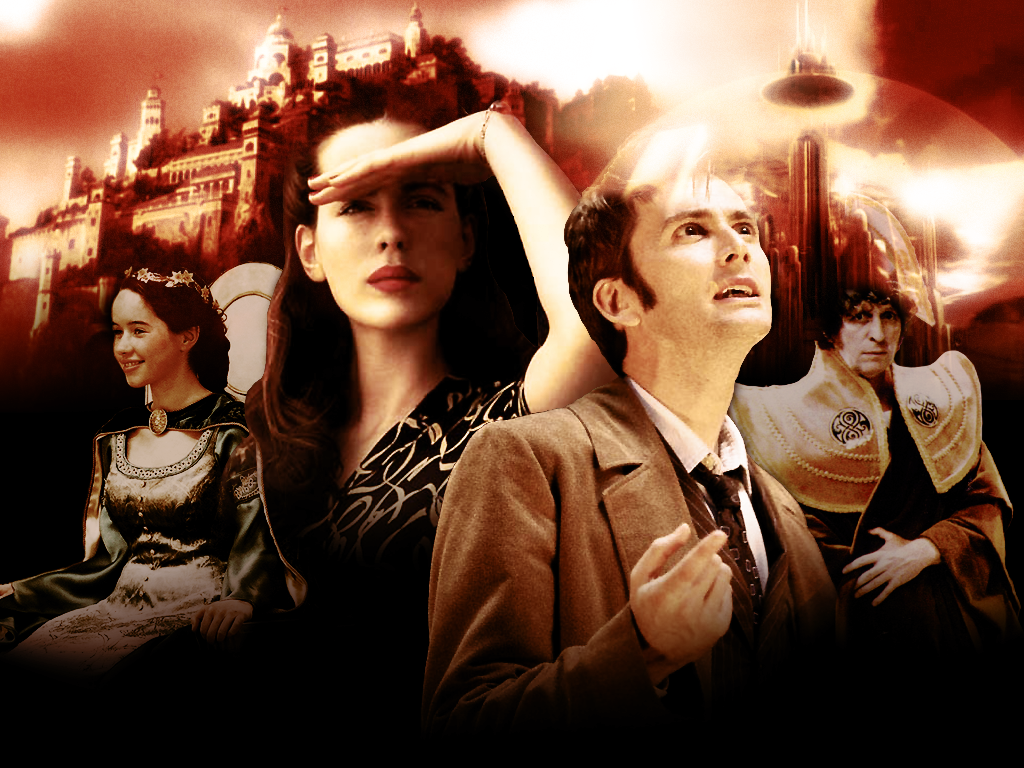
Fic: From a World More Full of Weeping (DW/Narnia, gen)

Author’s note: Set after season 4 for Doctor Who and after The Last Battle for Narnia (sort of a bookverse/movieverse hybrid–briefly mentions an event from the film version of Prince Caspian and presumes movieverse casting). Title is from the last stanza of “The Stolen Child” by W.B. Yeats (yes, the same one quoted in the Torchwood episode *g*).


tensusan2


“What are you doing?” the words came out sharper than Susan had intended, but nonetheless she put her own work down and crossed the shop in a few quick strides to where Mary was folding jumpers to lay them out on a shelf. Snatching the grey cardigan out of the younger girl’s hands, she shook it out and began to re-fold it properly. “Leave it on the shelf in that shabby pile and it’ll be certain to stay there. Honestly!”

Mary started to stammer. “I’m sorry, I–”

Tori interrupted crossly. “Oh, leave her be, Susan. It’s only her first week.”

“And that’s supposed to mean what, exactly? That no one ever taught her to fold clothes before she came to work in a dress shop?” Susan snapped, pivoting back to Mary. “Surely your mother wouldn’t find this acceptable either. Go help Liz sweep out the back for tonight. I’ll finish up this display.”

She ignored the embarrassment in Mary’s eyes, deliberately turning her back and focusing on her work.

She’d been too harsh with her, Susan knew that, but it seemed she couldn’t help it these days. She only ever didn’t feel angry when she stopped trying to hold back the tears.

The trouble was when she didn’t hold back, they came pouring out forever.

There were times, especially this time of year with Christmas fast approaching, when keeping busy seemed the only way to keep from falling apart. So, busy she kept, her hands occupied with folding and her mind for once, blessedly quiet.

The street outside was dark and quiet. Most of the other shops had also closed for the night, so the only light filtered dimly through shuttered windows or fell from dim yellow street lamps. A light carpet of snow lay outside, and something about the combination of snow and lamp-posts made Susan’s stomach tighten. She wasn’t looking forward to the walk home, and not just because it grew dark so early this time of year.

Shivering with something other than cold, Susan turned away from the window.

She’d worked as a clerk at Miss Tudor’s dress shop for nearly three years now: one before the railway accident that had turned her world upside down, and two after. Miss Tudor herself, bless her heart, had been most understanding when Susan needed time off to mourn and make funeral preparations, and equally so when she’d begged to return to work: the long, hauntingly quiet days in that empty house grown too much to bear. So she’d sold the house, put the money away into a small nest egg and found herself a small flat not far from the shop.

Susan had tried to go back to her old life after the funeral–filling her days with work and her nights with parties–but without Mum, Dad, Peter, Edmund and Lucy to disapprove and get her back up, it was all too easy to see for the hollow thing it really was.

These days, all dining and dancing did was to remind her of the time she’d wasted, time she might’ve spent with her family. Most nights she went straight home, ate a quiet dinner alone and went to bed early. It was a lonely life, but lonely was safe.

She had company enough in the persons of her ghosts. Friends were only losses waiting to happen.

“Susan, dear?”

Susan froze, feeling instantly ashamed of actions she’d nearly forgotten a moment before. “Yes, Miss Tudor?”

The older woman came up beside her, laying a kindly hand on her shoulder. “I know the Christmas holiday is difficult for you, dear. Still, do try to remember that Mary really is a good girl, she’s just very inexperienced.”

Susan grimaced. “Does it really matter what she thinks of me? Even if I’d done nothing, Tori and Liz would turn her soon enough.”

Miss Tudor let out a deep sigh. “No, dear, I fear you do that all on your own,” she corrected gently. “They’re young and careless, Susan, just like you were when you started here. It isn’t fair to hold your own tragedy against them because they haven’t suffered the like.”

She might have appeared frail, with her thin, wrinkled body and her brittle silver hair, but there was very little that Miss Tudor was afraid to confront. It was part of the reason for Susan’s loyalty–she made her think of the woman Lucy might have grown up to be had she lived.

“I think we’ve done enough,” Miss Tudor declared after a long moment’s silence. “You go on, Susan. I’ll fetch the girls and lock up behind.”

Perhaps sensing Susan’s hesitation, she added, “I can send Sam along if it’ll make you feel safer.” Sam was her brother; the two of them lived in a flat above the shop.

“No, I’ll be all right,” Susan assured her hastily. “You know my flat’s not far and I can look after myself.”

“Yes, I fear you’ve gotten far too good at looking after yourself,” Miss Tudor agreed with a shrewd but sympathetic look. “Run along, then. We’ll see you on Monday.”

+++

She hadn’t gotten far from the shop when the other girls emerged; not far enough, at least, that Mary didn’t run after her.

“Susan?” she called breathlessly, snow flying around her feet. “I’m told…well, Liz and Tori and I are off to the pub for a bit before we head off home, and I thought you might like to join us.”

Susan stopped, startled by the offer. For a moment, she thought about Miss Tudor’s words and nearly said yes, but then she glanced over at Tori and Liz, who were watching the scene with obvious distaste. Clearly it had been Mary’s idea, not theirs, to invite her along.

It was stupid that that should matter, but it did. Susan lifted her chin. “Thanks, but no.” Pride made her add, “I’ve a previous engagement.”

Mary looked half disappointed and half relieved. “Oh…well, perhaps some other time?”

“Perhaps,” she agreed without much conviction.

She watched as Mary turned back to the other two. They were close enough that she was able to catch a bit of their conversation without even trying:

“…knew she wouldn’t. Too good for us, that one. I want to know who died and left her queen?”

Tori let out a delightfully scandalised gasp. “Liz! That’s a dreadful thing to say!”

“Why is it?” Mary asked, sounding bewildered.

“Ooh, that’s right, you haven’t heard the whole tragic tale…”

Reeling, Susan stumbled away towards home. It wasn’t what they thought of her that shook her; that she’d known for a while now. It was the words themselves: …who died and left her queen?

No, she scolded herself fiercely, fighting the thought that threatened to bubble to the surface. There was no way she was going to let one careless remark drag her back down into a morass of childhood fantasies, the selfsame fantasies that had cost her a relationship with her siblings and them their lives. No, it wasn’t real.

Unfortunately, the internal battle wasn’t so easy to win. By the time she emerged from it feeling even moderately victorious, she looked up to discover she was no nearer her flat than she’d been when she left the shop. She’d gone the wrong way, wound up somehow in a narrow street that was entirely deserted.

Well, deserted but for the skinny man in the brown pinstriped suit and long coat who was running towards her, waving his arms like a madman. “Look sharp!” he shouted at her, genuine alarm in his voice.

Susan ducked instinctively, just in time for a large black shape to swoop over her head in the night sky. She looked up just the thing that had narrowly missed her flew across the full moon, casting its shape into silhouette. An impossible silhouette.

She stumbled backwards, landing square on the seat of her wool coat in the snow. By now the pinstriped man had reached her, and Susan saw to her disbelief that he had a quiver of arrows slung over his shoulder and carried a longbow in one hand.

“Sorry ’bout that,” the man informed her cheerfully. “I’m the Doctor, by the way. And you would be?”

She was too stunned to answer, spitting out instead, “What…what was that?”

“What’d it look like?” he answered her question with one of his own, giving her a curious look out of the corner of his eyes.

Susan shook her head emphatically. “It can’t be what it looks like!”

“Oh?”

Dear God, he was worse than Peter, Ed and Lucy towards the end. “Dragons don’t exist!” she stated adamantly. “Not in England, not now!”

“Nope, they don’t,” he agreed, and for one blissful moment Susan thought the man might be sane after all. Until he added, “However, a full-grown vortisaur can look and behave remarkably like a dragon, if provoked.” He waved the bow at her. “See this? Anachronistic weapon. Picked it up from a fellow by the name of Locksley, used to hang about in Sherwood forest…though perhaps hang isn’t quite the right word, much a certain authorities might have wished it to be. Vortisaurs feed on temporal energy, so in theory if I can hit it with one of these arrows, it should pop right back into the Vortex.”

He whipped out an arrow, sighted and fired. The projectile went soaring right past the creature, who turned its head briefly as though in idle curiosity, then circled around and dove for them once again. The Doctor yelped, pulling Susan to the ground.

“You can’t practice archery in this light,” she protested. “It’s ridiculous; how could you possibly think to hit a target you can’t even see?”

“Yes, that does appear to be a problem, doesn’t it?” he mused. “Suppose I could lure it back to the TARDIS, but that didn’t work so well the last time. Of course, that could be because my companion at the time was a walking paradox, but then…” The Doctor glanced at her, frowning. “There seems to be something rather temporally odd about you, too. This may sound weird, but have you been this age once before?”

Susan’s heart almost stopped and she could feel all the colour drain from her face. “What?”

“It’s just, when I look at you, it’s as though part of your life was rewound and started over,” he answered, still frowning. “Very strange…never seen anything quite like it.”

“How did you…?” No, they were childhood fantasies, they weren’t real! She hadn’t been this age before, hadn’t been courted by the lords and princes of half a dozen realms and rejected them all because some part of her knew, though she hated it, that she didn’t belong to that world and would one day have to give it up.

He grinned, not seeming to notice her growing consternation. “I’m a Time Lord. S’what we do.”

Heart pounding, Susan insisted sharply, “Don’t you think you ought to be doing something about the dragon–or whatever it is–before you worry about me?”

“What?” He looked at her blankly for a moment. “Oh! Right–vortisaur, twentieth-century London: bad combination.”

It was at that moment that Susan lost patience. “Oh, honestly, give me that!” She plucked off her gloves and snatched the longbow out of his hands. Grabbing an arrow from the quiver, she notched it to the string of the bow with uncomfortably practiced ease. “I don’t suppose you could manage to summon up a bit more light?”

The Doctor’s eyes brightened. “Right!” Grabbing some sort of odd silver wand out of his pocket, he jogged over to the nearest street lamp. Shimmying up it as though he were part monkey, he popped off one globe after another, waved the device at the bulbs and all at once the light from each grew brighter. “How’s that?”

It didn’t help much, but then she’d used a bow effectively in far less light before. An image flashed into her mind of a dark castle courtyard: caught up as she was in trying to spot some vulnerability on the creature he’d called a vortisaur, for once she didn’t force it aside.

The important thing was she could see well enough to note that the vortisaur was not scaled like a dragon, therefore there was no need to seek out the rare hole in the armour (caused by moulted scales that failed to re-grow) that was a dragon’s only weakness. She didn’t want to kill, so she aimed instead for the right forelimb, right where it would disable the wing without tearing it. Pausing only a moment to relax into the feel of the weapon and let her body remember it, she drew back the string and let the arrow fly.

When the metal shaft struck true and the creature vanished with an indignant cry, she felt a swell of unexpected pride and triumph; not what she would’ve expected to associate with a skill so closely tied in her mind to those dreams she’d long ago rejected. Lowering the bow slowly, Susan glanced over at the Doctor.

He was smiling like ten sorts of madmen all at once, yet remarkably Susan wasn’t afraid. In fact, she felt braver than she’d done in years: it was as though just having the bow in her hands made her a different person. Who that person was…well, whether she had the courage to examine that or no she still wasn’t certain.

“Brilliant!” he exclaimed, hopping down from the lamp-post and crossing back over to her. “Remind me to take you along the next time I go vortisaur hunting. Just one question–how does a mid-twentieth-century shop girl learn to wield the longbow as though she were born to it?”

“I…I don’t…” Susan stammered for a moment, still trying to hold back the tide of memories or dreams or whatever it was–the certainty that had been shaken by her family’s deaths was teetering on the edge of oblivion now. Desperately her mind seized onto an escape. “Wait a moment, how do you know where I work? Have you been following me?”

“What? No!” the Doctor looked startled, then embarrassed. “Well…I might’ve followed the vortisaur, and it does appear the vortisaur was following you. As I said, you’ve a rather peculiar temporal signature, Miss…” He paused, then. “I don’t believe I ever did catch your name.”

Relieved to be back on safe territory, she answered him. “Pevensie. Susan Pevensie.”

The Doctor froze, every bit of colour draining from his face until it looked as though his dark hair and eyes might begin to fade next. He shook it off quickly, though, turning away from her with only a hint of strain in his overly-casual voice. “Well, best be getting on. Places to go, worlds to save.”

“Wait a moment,” Susan objected. “You can’t just…” She stopped suddenly, not entirely sure she wanted the answer to the question that had been on her lips.

He looked back at her. “Can’t what?”

She didn’t answer, but rather found herself blurting out impatiently instead: “Who are you?”

The Doctor grinned. “I told you: I’m the Doctor.”

“You say that as though it’s meant to tell me everything about you,” Susan protested. “Well, I’m sorry but it doesn’t. Not nearly.”

“No more than your name tells all there is to know about you, I wager,” the Doctor answered, eyeing her shrewdly. “Would you like to know more, then, Susan Pevensie? About me? Possibly even about yourself?” He held out one hand.

Susan hesitated, her heart pounding against her ribs as though eager for something the rest of her still feared. Don’t, a familiar voice whispered inside her. If you do, you’ll never be able to go back. Take his hand and you doom yourself forever to be who you are, not who you want to be.

For probably the first time since she’d returned home from America all those years ago, Susan didn’t listen to that voice. She took his hand, felt slender fingers curl around her own, and gave the most dangerous answer to his question that she could: “Yes…yes, I rather think I would.”

The Doctor grinned and she suddenly found herself being pulled along one street after another, some familiar and some not.

When they finally reached their destination, however, Susan felt a sharp sting of betrayal.

“There she is!” the Doctor exclaimed proudly. “That’s the TARDIS.”

Not that she oughtn’t have expected it, Susan thought sourly: naturally the one time she let her control slip and began to believe, even for a moment, that there might be something out there more magical, the world had to show her just how very ordinary it was.

“A police box?” she asked coldly. “That’s your grand secret, that you’re a policeman?”

The Doctor smiled again, and there was something odd in that smile. “Just you wait.” Pulling a key on a long chain out from under his collar, he slipped it into the lock and opened the door.

There was a room inside. A room that couldn’t possibly fit into the box, anymore than a forest could fit into a wardrobe. This was it, then–what the voice had been warning her about. This was the point of no return, because if she stepped across the threshold and accepted that impossible space, then all the excuses she’d crafted so carefully to justify to herself why her memories of Narnia couldn’t possibly be true crumbled to dust. Reality in all its beautiful, magical, perilous glory forced its way into her limited mind and tore down those walls, confronting her with the harsher truth that she had thrown away everything she loved for an illusion of safety.

That was the truth she’d been hiding from. But in doing so, she’d given up the memories of a lifetime and allowed herself to lose her family not just once, but twice.

In that instant, Susan saw herself for who she was and reclaimed it. She stepped over the threshold and looked calmly at the Doctor, who was waiting for her with eager, expectant eyes.

“Well?” he asked. “Aren’t you going to say it?”

“Say what?” Susan asked.

“That it’s bigger on the inside?”

Susan the Gentle, Queen of Narnia, smiled. “Yes, I suppose it is. But then, my sister once found an entire country in the upstairs wardrobe.”

Posted in Crossovers, Doctor Who, Gen, The Chronicles of Narnia, The Chronicles of Narnia/Doctor Who | Tagged , , , , , , | Leave a comment

Fic: Given to Serve (Narnia, gen)

Peter didn’t leave. Long after Susan had stormed off, Caspian had left to deal with his private demons alone and Edmund and the others had gone to dispose of the bodies of the hag, the werewolf and Nikabrik, Peter just sat, staring at the shattered wall of ice and the image of Aslan behind it. So Lucy lingered too, watching him. Worrying about him, just as she had been since long before they’d come back.

He seemed to sense her presence, even though she knew she was out of sight, because he spoke to her: “Was I a good king, Lu?”

Lucy laughed at the absurdity of the question. “Would Aslan have made you High King if you weren’t?” When he didn’t answer, she realized he’d been serious. “Peter?”

He glanced back at her over his shoulder, but only for a moment before his eyes swung back to the carving of Aslan. “I was so sure, so certain I was doing the right thing. But you were right: I didn’t listen. And a lot of our people were killed.” The agony in his voice tore at her heart. “They trusted me and I led them to their deaths.”

Now Lucy understood. “If you’re asking if you were a good king last night? Then no, you weren’t,” she answered bluntly but gently. “But if you’re asking if you were a good king when we ruled here…yes, you were. Don’t you remember what you said to me the first time you and the others ever included me in a major decision of state, and I didn’t want to be?”

She couldn’t see his face yet, but she could tell by the tilt of his head that he was probably frowning. “No…no, I don’t.”

“I complained that matters of state weren’t any fun, and you said, ‘Being a king or queen isn’t about having fun. It’s about putting the best interests of the people you’ve been given to serve ahead of your own.'”

“I’d forgotten that,” he answered softly.

She nodded. “Last night, yes, I think you did. Perhaps that’s why Aslan didn’t send us here to be kings and queens again, but to help Caspian become king. Maybe he knew we wanted it too much.”

Peter didn’t answer her for a long moment, long enough to finally give Lucy the courage to approach him and sit down at his side.

“You’re lucky, you know,” Peter finally said, so softly she nearly couldn’t hear him.

Lucy looked at him. “What do you mean?”

“To have seen Him. I wish He’d just given me…” He struggled to find the words as she turned her own eyes to the image of Aslan on the wall of the How. “…some sort of proof.”

Lucy thought about all they’d seen since returning…and all they hadn’t. Susan and Peter had both asked why they hadn’t seen Aslan, and she had given them the only answer she could. But now, thinking about it, she realized how easy it had been the last time. She was still young, but old enough to know that life didn’t always hand you the answers and the happy ending. Maybe now that they were older, they had to earn it.

She twined her hand in his, squeezing it to reassure him just as he’d done for her so many times when she was frightened or confused, both in Narnia and in England. “Maybe we’re the ones who need to prove ourselves to Him.”

Peter looked at her, then looked up again, and in that moment Lucy knew she had her brother back, instead of the boy who’d missed the man and the king he’d been so much that he’d forgotten all the things that had made him that man and that king.

And if Peter was back…her Peter…then maybe, just maybe, everything would be all right.

Posted in Gen, The Chronicles of Narnia | Tagged , , , | Leave a comment

Fic: The Last Queen (Narnia, gen)

Author’s note: I took some liberties with the history of Charn and its final days as recorded in The Magician’s Nephew on the presumption that Jadis was an unreliable narrator. For the record, my narrator probably is too. Make of that what you will. Also, thanks so much to my beta readers, Trialia and Christina A!


As I write this, the great city of Charn lies before me, bathed a blood-stained red by the light of the rising sun. For months now, my army and I have laid siege to the city, but its gates remained barred against me. No longer, though.

My forces outnumber my sister’s ten times over, and every day more flee to my side, their loyalty to the Heir of Charn broken by her actions. By this time tomorrow, the fate of all of us will be decided. Though it grieves me to do so, I shall wipe out what little remain of my sister’s forces before the day has passed. What she will do in her defeat, I cannot say. It may be she must die to truly end this strife between us, though I do not relish the thought.

Improbable as it seems, I have always loved my sister. How could I not? If the lore of our ancestors is correct, we are of one soul, divided somehow at birth and both diminished for it.

I know it is whispered amongst those who have chosen me as their queen that I am everything that ought to have been good in her, while she is all that might have been ill in me, but in truth we are more intertwined. There is ill in me, just as there is good in her, though it is buried deep enough that I believe even she may not know it. Yet for all that we were raised side by side, our lives were very different, and our disparate natures were surely the result. Jadis was raised to believe that everything–even the world itself–was hers by right; I was the undesired second, and though it was death to tell me so, those around us had other means of making certain I knew it.

If I had been slain at birth to restore to Jadis the other half of our soul, as is the custom of our people with twins who share the same face, perhaps she would have been possessed of greater compassion. But again, perhaps there would merely have been no one with the will to stand against her.

It is said that once our ancestors were wise and just rulers, beloved by the people they served. But that was in a day when the sun gave greater light, when day and night and the seasons of the year were in balance. In a dying world, it is much easier to give way to greed and avarice: to try to gather to oneself what one can so long as there is anything to gather.

When Jadis and I were born, our world was already dying. The sun hung low and great in the sky. It cast its dull red radiance over the sweat-stained brow of our mother, Queen Lilith, as she labored to bring forth her firstborn child, even as it shall today over this battle which will decide the fate of Charn. It is said that when Jadis drew her first breath, she cried out as though she knew that from this moment, contentment would be forevermore beyond her grasp.

It would not surprise me if this were so. Certainly it was made clear to us at a very young age that ours was to be a high and lonely destiny, untouched by mortal concerns and absent the simplest of mortal comforts or pleasures such as friendship or love. For we were not ordinary mortals, but daughters of the Great House of Charn; the blood of giants and djinn and sorcerers flowed in our veins. And Jadis was no mere daughter, but firstborn and heir to the Queen of Queens.

Is it any wonder that our mother named her for the great queen of ancient times who had conquered the world beyond the walls of Charn and made all other kings and queens bow down and offer her their fealty?

If Jadis wept at our birth to know that she would henceforth be forever feared and never loved, then surely I must have wept to leave the shelter of our mother’s womb. For when Queen Lilith labored and brought forth another child, like the first in every aspect, I do not have to be told that those with her in the birthing chamber began to whisper in apprehension. Such an ill omen at such an evil time surely presaged destruction and conflict on a scale not seen since the House of Charn overcame all its opponents to establish its rule over the whole world.

But my mother knew their thoughts and cursed them all for weak-minded fools: a daughter of the House of Charn had ever been a cause for rejoicing, and she would have the head of any who dared stir up discontent amongst the populace by suggesting that two were not more so.

Perhaps if they could have seen this day, they would have rebelled against my mother’s objection and had me slain regardless. As it was, Queen Lilith was feared more than she was loved, so none dared defy her. I too was handed over to the wet-nurse, and Her Majesty returned to the work of ruling her people.

Thus passed the first five summers of our life: with only our Nurse and each other for company save on the rare occasion when the Queen, our mother, saw fit to bestow her presence on the children she had borne.

One such occasion is the subject of my earliest recollection. It was winter, and the great storms howled with relentless fury about the walls of the Palace, such that none dared venture through them–in or out.

In this, the twilight of Charn, the winters are long and even the summers cold and dim, and have been for all of living memory. We have prayed to the Powers for mercy and relief for ages, but they have not answered our prayers. Some, I know, even directed their prayers to my mother, whose djinn blood was powerful enough to command even the elements. But the Queen was no more merciful than the gods. It would not do–she taught us as she was taught–to allow the common folk to forget how dearly they depended upon us by giving too freely of the power we possessed.

It was an edict I would later learn to question, but then I was too young and of too little value to question anything.

On this day, the world outside the heavy glass panes of our windows was nothing but a swirl of blinding white, even in the courtyards. Jadis had always been entranced by the power of the storm, a power even she could not–yet–command. But on this day, merely watching its fury through the glass ceased to be enough for her, and she commanded Nurse to take us out into the courtyard that she might experience the storm for herself.

Nurse had no more desire to do so than I, but Jadis was the Heir and must be obeyed. So the guards unbarred the door and let us out into the white, but watched closely so they might intervene should our safety–the only thing more important than Jadis’ wishes–be threatened.

In truth, the snow that lay over the courtyard like a blanket of tiny, sparkling jewels was beautiful, despite the chill winds that challenged the protection of even our heaviest furs. Though even then I knew it would do me no good, I wept at the fierceness of the cold as it whipped my hair and buffeted my face. But Jadis turned her face to the sky and let the wind strike as hard as it may. It was intoxicating to her; this untamed force of nature, enough so that she did not even break the stillness to mock me for my weakness as she would otherwise have done.

I cannot remember how long we stood there in the snow, Jadis as still and unmoving as stone while Nurse and I shivered and prayed to be allowed to return to the comfort and protection of our chambers. But when we did venture once again in-doors, our faces flushed red with the cold, we found our mother waiting. So, while Nurse hung our wet clothes to dry before the fire, the Queen gathered us on her knee and told us stories of our ancestors who had ruled Charn with fists of iron.

She spoke of our great-grandfather, who had been beset on every side by treachery because he had the misfortune to be born a son. Of the thousand noble families, seven hundred had rebelled against him in their thoughts. But he bade all his enemies attend him at a banquet and slew them in their cups, then stripped all their kin of their titles and property and banished them to the poorest streets of the city. Thus did he prove himself a true scion of the House of Charn.

She also spoke at length of Jadis’ namesake: she who had led an army against the kings and queens of all the realms and made the whole world bow down before the might of Charn.

Of the earliest figures in the Hall of Images, those whose faces still showed kindness and compassion, she did not speak; save to say that they were a reminder of what the House of Charn had once been, and might become again if its rulers did not remain strong and unyielding.

Late into the night, we sat together: Queen Lilith and her daughters. And when the next day came, with the storm still beating against the outer walls of the Palace and barring its threshold, she came again to our chamber and began to teach us the first rudimentary workings of magic: how to hold a single snowflake suspended in the air and keep it from melting, and how to create a spark to light the fire in the hearth.

Had the gates been unbarred or had there been nothing to teach us that could not be taught by another, I know well our mother would never have come to us. But to the children we were, it mattered only that she had come.

Her enemies will say that Jadis is incapable of love, but I know they are wrong. For from that day in the storm, Jadis loved winter. She loves it to this day, though the woman she became has long forgotten the child’s reasons. But even as this war raged between us, there have been moments when I have seen her tip her face to the sky and call down the storm with the smile of one welcoming a lover.

And for that, I know I have none to blame but myself. It was I who broke our pact not to use magic in our struggle against each other. Perhaps I should not have done so, but in such desperate straits as I had been then, it seemed the only way to ensure victory. I was ever the stronger in sorcery, though Jadis and even our mother might have wished otherwise. Still, if so many fates aside from mine did not ride upon the success of what we do here, perhaps I would have been content to fight a mortal battle. If I had known how much she had grown in power since our war began, I would not have dared to challenge her on that plain.

If so many had not deserted to my side, I would long since have been defeated.

Perhaps if our lives had taken but a slightly different turn, I would have been content to remain loyal to my sister as I was always intended to. When we were young, though she had everything and I nothing, I worshiped her as I worshiped my mother. Even when they did me injury, they could do me no wrong. For I had no sense of my own worth, let alone that of any person beyond our castle walls.

We had a tutor, once, who tried to open our eyes to the world outside our narrow, privileged one, to the people we would one day rule and ought to care for as well. She loved us both; the only one who ever did, I think. But Jadis was never able to see Sular’s concern for the common folk or her refusal to bend to Jadis’ every whim for the kindness it was, so while my eyes were opened, hers only closed all the more. So, after Sular broke all rules of conduct by taking us beyond the palace walls into the city so that we might see for ourselves how our subjects suffered, she gave an account of it all to our mother, who had Sular executed as a traitor.

It was then that the rift between us truly began. I wept for days following Sular’s execution, save where our mother might see. Jadis had never doubted her own superiority over me, but my grief only confirmed my weakness in her eyes. And I could not forgive her for taking from me the one person who had ever looked on me with kindness.

Yet I loved her still, even as the distance between us only widened with time.

In our sixteenth summer, the last of our tutors was sent away. They had taught us all that was within their power to do and, as we had reached our majority, were no longer needed. Now was the time for us to take our place at our mother’s side. For the first time since Sular had smuggled us beyond the palace walls, we were permitted to venture out into the city, and even beyond it to the distant lands that lay under Charn’s rule. We were our mother’s ambassadors, speaking on her behalf and meant to act as she would act.

Sometimes we were dispatched apart to distant lands far from each other and further from our home. More often, though, we were sent together. The Queen had never forgotten the superstition that accompanied our birth. Save in lands where the belief in divided souls had never taken root, she never failed to present us as a united front.

Yet the illusion that Jadis and I were one in mind wore ever thinner, for wherever we embarked I saw again the squalor and fearfulness of the people that Sular had first brought to my notice. I saw also that Jadis had learned our mother’s lessons too well. I knew now what kind of queen she would be–not better; if anything, worse–and I was helpless to do anything to prevent it.

Or so I believed. For all that I had changed, for all that I had emerged from Jadis’ shadow, it still would not have occurred to me to defy her. Until happenstance saw us sent as ambassadors to the land of Sular’s birth, and to the House of Anak that had borne her. It had been in disgrace since Sular’s execution, yet somehow they had not fallen prey to the same fate as those seven hundred houses torn down by our great-grandfather.

We were received in state by Sular’s father. He had the same bronze complexion and black hair as his daughter, but more importantly, he met my eyes with the same compassion. It was as though he held us blameless in his daughter’s death, though surely he must have known the truth.

In Jadis’ presence, he was as obsequious and flattering as any noble of the Three Hundred Houses. He had learned long ago, no doubt, that to protect his people his own loyalty to the House of Charn must seem absolute. Yet he watched us both carefully from the moment we arrived. Though I tried to conceal it, he saw through the mask of my own loyalty to the distress I felt at my sister’s casual cruelty.

Only once he was certain I could be trusted did he approach me alone, in the gardens of his great estate. Only then did he broach the greatest treason of all: to suggest that perhaps it was I, rather than Jadis, who should sit upon the throne of Charn.

It would serve no purpose to enumerate the events which transpired after that. If this account is to be read at all, it will be only by those who fought alongside me to bring us to this day.

That the fight and all the death it has brought might have been avoided had I but had the courage to assassinate my sister in the days following our mother’s sudden death, I am all too aware. But as I have said, I loved her still. She was my twin, and even at our most estranged there were moments when I had only to look at her to know what was in her heart. So I sought instead to win the throne through treachery, by declaring publicly that it had been confided to me by our wet nurse that I, not Jadis, was truly the firstborn.

I was naïve to think she would believe it, even if all the rest of the world had done so. I was foolish to believe she would let go her claim without a fight, even if she had believed. And so I condemned our world to this final, brutal war. Perhaps the midwives who whispered I would bring about our people’s ultimate destruction were right.

The sun beats down on me strongly now, and I must set this aside to finish the battle once and for all. We ought to have struck at dawn, but Jadis holds the city with but a few loyal men and women who are by now half-starved from our siege. Had we waited until the sun began to set, the city would still be ours before full dark.

Strangely, even though I know our victory is assured, I feel a strange foreboding within me, as though I stood instead on the brink of crushing defeat. Perhaps it is merely that the cost of this war has been far too high. Perhaps it is the bond between Jadis and I flaring to life one last time, and it is her despair that grips my soul. It matters little. The time for contemplation is past. Now is the time to finish this.

I have always loved my sister, but I love my world more.

“The last great battle,” said the Queen, “raged for three days here in Charn itself. For three days I looked down upon it from this very spot. I did not use my power till the last of my soldiers had fallen, and the accursed woman, my sister, at the head of her rebels was halfway up those great stairs that lead up from the city to the terrace. Then I waited till we were so close that we could see one another’s faces. She flashed her horrible, wicked eyes upon me and said, “Victory.” “Yes,” said I, “Victory, but not yours.” Then I spoke the Deplorable Word. A moment later I was the only living thing beneath the sun.”

The Magician’s Nephew

Posted in Gen, The Chronicles of Narnia | Tagged , , , | Leave a comment

Fic: Something Beyond Our Wishes (B5, Sinclair/Garibaldi)

Author’s note: This is sort-of-but-not-really a companion fic to my story, “Five Ways Garibaldi Followed Sinclair Back Through Time.” Sort of because the concept of Mah’hel is introduced in that story, but how Valen gets his Mah’hel is different in this one. All Minbari names/words are taken either directly or interpretively from the Minbari dictionary at jumpnow.de.

Written for: lizardbeth_j on LiveJournal, for fandom_stocking.


Destiny grants us our wishes, but in its own way, in order to give us something beyond our wishes.
-Johann Wolfgang von Goethe

That funny little alien, Zathras, has disappeared and it’s probably just as well. This is something he and Jeff have to work out on their own, preferably without an audience.

Michael’s not stupid. He may not know as much about Minbari culture as Jeff, but he sure as hell knows enough to know the role Mah’hel plays in Valen’s story: Ma’fela, male lover. Surprisingly, he’s okay with it. After all, it’s not like it’s the first time he’s thrown everything away to follow Jeff. Nor is it the craziest thing he’s ever done for him. Hell, if Lise knew, she would probably laugh and say she’d seen this coming a long time ago.

Jeff’s the one who’s going to have to get used to the idea. He’s the one who tried to sidestep fate by sending Michael back to Babylon 5. Garibaldi doesn’t know what instinct it was that made him disobey Sheridan’s direct order and turn back around, catching up just in time to get caught up in the time shift, but he’s damned grateful for it. He wouldn’t have missed this for the universe. This is the moment he was born for.

He just has to convince Jeff of that, and if Zathras’ cryptic warnings are anything to go by, he only has a limited amount of time in which to do it. (Ironic, considering they’re time traveling.)

Good thing it’s only his second favorite thing in the universe he has to leave behind.

“You gonna give me the silent treatment for the next thousand years?” Garibaldi asks dryly.

Jeff turns. Even with this new acceptance, it surprises Michael how quickly he’s turned on by the power and grace in his friend’s body and movements, something that was always there but is only enhanced by the way the brown silk Minbari robes fall around him. (Huh. So maybe that little obsession with how Jeff put his pants on wasn’t just idle curiosity after all.)

“You shouldn’t be here,” Jeff answers gruffly.

Michael snorts. “Oh, please. If I wasn’t supposed to be here, I wouldn’t be here. What, did you think you were just gonna find a Mah’hel at the corner grocery store or something? Did they even have grocery stores on Minbar a thousand years ago?”

Jeff’s eyes darken. “Michael–” he starts, warningly.

That’s Jeff for you. Always trying to play the Lone Ranger (and frankly the Minbari didn’t exactly help matters by slapping the “Ranger One” title on him). Garibaldi closes the distance between them. “It’s the hair, right? You’re worried that because I’ve already got less hair than you, I might make a better Minbari after all and they’ll all decide to follow me instead.”

Jeff’s mouth twitches, despite his best efforts to remain stern. “Michael–” he repeats, but his tone is softer in spite of itself.

Oh, hell, might as well get right to the point. “Is it the sex? ‘Cause while I admit I’m no expert on Minbari anatomy, as far as human intercourse goes, I’m told I’m pretty damn good. And don’t try telling me you don’t find me attractive either, ’cause c’mon, who wouldn’t want a piece of this?” He grins, waggling an eyebrow suggestively.

Of course, he has no idea if this’ll even work. They are both, after all, a good twenty if not forty years older–physically anyway–than they were this morning. But hey, nothing ventured and all that, right?

“Mich–” Jeff starts to repeat yet again, but he’s definitely smiling this time. Michael cuts him off with a kiss, and not a gentle one either. It’s the hungry, devouring kind that leaves even him a little frightened by its intensity. Jeff’s pulled up flush against him, close enough for Michael to tell that whatever else his destiny may be, Jeff Sinclair is definitely no Jesus.

“See?” Mike gasps once Jeff realizes what he’s doing and pushes him away. “That wasn’t so bad, was it?”

“Damn it, Michael, don’t you take anything seriously?” Jeff explodes, his face darkening again. “I didn’t want this for you. I had Sheridan send you away so you wouldn’t have to spend the rest of your life a thousand years away from friends, family, everything you know, in a culture you barely understand–”

“Hey, if it’s good enough for you, it’s good enough for me: you’ve got a lot more to lose than I do, and that hasn’t stopped you from going.”

“I had the chance to make my peace with what I’d be giving up; you didn’t.”

“Only because you didn’t give me that chance!” Michael almost shouts. “But that doesn’t matter, because it wouldn’t change a goddamned thing. I still would’ve made the same choice, and you know that. What you didn’t think about was that it was my choice to make, not yours.”

There’s a physical distance between them again, one that he knows Jeff put there deliberately. Damn it: if the man can’t even believe that Michael would willingly follow him to the ends of the universe, how the hell is he going to convince an entire planet to do so?

But then that’s the difference, isn’t it? Jeff’s a leader of men, he always has been. He’s never had a problem seeing his duty clear and following it or convincing others to follow him if it’s for the greater good. But he’s never understood why. He just does it because it’s what’s expected of him. But it’s one thing to lead armies over a cliff because destiny demands it. It’s something else when it’s someone you love.

The idea that Michael is here because he wants to be, not because history or destiny or even friendship or love demands it of him…that’s something that would probably never even occur to Jeff.

As if to confirm that, Jeff answers dryly, “I wasn’t aware that either of us were being offered a choice.”

Garibaldi shakes his head, advancing on his friend again. Well, he’ll just have to make it occur to him, because if there’s one thing he’s not willing to spend the rest of his life doing, it’s watching Jeff dodge him out of some misguided sense of guilt.

“You really think if I didn’t want to be here, I wouldn’t have said ‘damn the consequences’ and gone back with the others?” he demands. He grabs Jeff by the shoulder, spins him around and pins him up against a bulkhead. “You know me better than that.”

“You didn’t say ‘damn the consequences’ and go back to Mars,” Jeff protests. “In spite of what it cost you.”

Oh, good grief. “Because I was right where I wanted to be.”

“You lost the love of your life–”

“I lost the woman I loved,” Michael corrects him. “Not the love of my life. You’re the love of my life, Jeff. I think you always have been.” He’s never voiced the words aloud before. Maybe he’s never even really thought them. But a part of him has always known it’s true.

The way Jeff is staring at him, though, it’s apparently news to him.

“If I could’ve found a way to spend my life with both you and Lise, I probably would’ve been the happiest guy in the universe,” Michael admits. “But I was never not gonna choose you, Jeff. Not then, not now.”

And there it is, finally. Acceptance: if a little tinged with wonder. “Michael–”

Michael interrupts. “If you don’t feel the same, that’s okay. I can wait. Forever, if I have to, as long as I can do that waiting here, with you. Not a hundred centuries in the future.”

“Michael, you damned idiot.” Jeff’s smiling again, but there’s something different in that smile this time. Just like there’s something different in the hand that reaches out to touch his face. Touch it in a tender, possessive way that makes Michael want to explode out of his skin. Damn. He can’t remember the last time he got this stiff this fast. (Guess that answers the age question.)

“If I didn’t feel the same, would I have tied myself in knots trying to protect you?” Jeff demands.

“Is that a rhetorical question?” Michael asks dryly. “Because knowing you, y–”

This time, Jeff is the one who shuts him up with a kiss.

From there, it’s pretty much a race to see who can get naked faster. (Answer: Michael, who is wearing a lot fewer layers.) Part of Garibaldi hates that it has to be this way. If there’s anyone in the universe with whom he’d want to take his time, take it slow and cherish every second, it’s Jeff. But there isn’t time. They have a chrysalis to build and a metamorphosis to undergo, and both have to be completed before they arrive at their destination. A sort-of-quickie might not be his first choice for their first time, but when the alternative is waiting until they arrive in the past, he’ll take what he can get. Michael might have made his peace with spending the rest of his life as Valen’s lover (and sharing him with a wife so he can have all those descendants he’s got running around the galaxy), but at least once he wants to be with Jeff as Jeff.

And, hell, intentions aside, the way Jeff is touching him doesn’t exactly do much for his staying power anyway. He wants this more badly than he’s ever wanted anything. More than he ever knew he could want anything. And having it? That blows even wanting it way out of the water.

It only surprises him that he didn’t figure that out a hell of a lot sooner.

Destiny. Not a word or a concept he’s ever had much use for. But then, there’s a lot of things he never had much use for that the last few hours have forced him to reevaluate. Like Valen: now that he knows the truth, for the first time he understands why the Minbari revere him so much. Because he too would follow this man into darkness, death, fire, and all that other crap. Hell, he already has.

Looking at his long-time best friend and new-minted lover, Michael finds himself pondering the Minbari name he’ll carry for the rest of his life: Mah’hel, his strength.

All things considered, it’s not a bad destiny to have.

Posted in Babylon 5, Sinclair/Garibaldi, Slash | Tagged , , , , , , , | Leave a comment

Fic: The Sceptre and the Isle (B5, gen)

Dedication: For lizardbeth_j, as promised a long time ago. I don’t think this is quite what you had in mind when you gave me the prompt, but I hope you’ll enjoy it anyway. Also, a couple of small details from your Sinclair fic have sort of entered into my personal fanon, so they’re included here. Hope you don’t mind!

Disclaimer: Babylon 5, its characters, arcs and languages all belong to JMS, Warner Brothers, etc. Title is taken from (big surprise, I know) Ulysses, by Alfred Lord Tennyson.

Acknowledgments: Alli for finally motivating me to sit down and watch the series in order–I’d caught episodes here and there during the show’s first run, but not *nearly* enough to really follow anything. Medie for patiently putting up with me while I a) discovered all the great things about this universe that she already knew and b) took forever to write this. *g* John Hightower for his help with the Minbari language and last but FAR from least, Mari for the invaluable beta!


Of course I appreciate the irony: that someone who mistrusts the Vorlons as much as I do should owe them his life so completely. I should have been dead nine hundred years ago, but the Vorlons weren’t exactly eager to be rid of such a useful tool as I turned out to be. Of course, they had my “prophecies” to tell them who they would need to fight their next great war, but I remember Delenn telling me that they still had doubts. That they had tested her, even before I left. Who knows if that test was–will be–the only one?

To the Vorlon way of thinking, it’s only logical that they would keep me around in case Delenn should fail in her task. Of course, they don’t know her the way I did.

Still, the stories only say that Valen “traveled beyond,” so, here I am once again, treading the path that history laid out for me a thousand years before I was born.

I spend most of my time asleep, of course–in stasis like the others–because with all their powers, the Vorlons haven’t yet figured out how to make a human or a Minbari immortal: since I am, in a way, both, I suppose that just makes me more of a challenge. But every once in a while–usually when there’s some task for me to perform to keep my legend alive–they let me out to stretch my legs.

It’s an appropriately strange denouement for my very strange life.

But on the upside are the things I’ve been privileged to see; things like my children and grandchildren coming home to the world of their birth, all questions about their origins long forgotten, or at least, forgiven.

More than that, I’ve been given the gift of anonymity. That’s something I’d almost forgotten: I was Valen for a hundred years, Entil’Zha and Ranger One before that, and Commander of Babylon 5 before that. I got used to being recognized.

No statues, no pictures, no images of any sort were made of me during my life on Minbar all those years ago. I saw to it because I knew if Delenn recognized me–or if I recognized myself–before the proper time, it could change everything. But because of that, here and now I can walk amongst the people I gave up my life for, unobserved and observant. Just another Minbari roaming the streets of Yedor.

It’s strange how reading so much about a life that would turn out to be mine would still have left me so unprepared for the reality of it–the unbearably high cost of it.

In another ironic twist, I find my steps have led me, as they often do, to the threshold of a temple. Not one of the grand temples at the heart of the city: I always feel ill at ease in those, even more unworthy of the veneration than I do here in these everyday streets. Oh, I knew the veneration would come, that it had to come for my words to echo forward through time to reach the ears of the ones they were meant for. Still, that didn’t stop me from trying to kill it in the cradle, to remind those I led that I was as mortal and as fallible as they were. I’m no Christ, no Son of God come down from heaven–just a man out of time, out of place and out of choices.

But this temple is…for lack of a better analogy, more inner city mission than Westminster Cathedral. And it’s in these back alley temples–the ones that touch the lives of the common Minbari of all castes–that I begin to come to terms with my own legacy.

This temple is dim and quiet; the only light filters in through the glass from outside. It’s apparently empty as well, and might well be abandoned if not for the care I can clearly see has gone into its maintenance: a simple honor that means more to me than all the statues, and not only because the statues don’t look a thing like me.

It’s been centuries since I was exposed to a religion I had no hand in establishing, but there are some stories from my Catholic youth that I still remember vividly. One of them is a parable Jesus told about two men at prayer: one, a proud Pharisee who loudly and publicly thanked God for his own righteousness so that all the world could hear, the other a humble tax collector who quietly and privately sought forgiveness for his sins.

Like the tax collector, this small but well-loved temple is the work of a true but humble heart. To be on the receiving end of that kind of devotion is…well, it’s humbling. It keeps me from ever being tempted to believe, like the Pharisee, that I somehow earned or deserved it.

Lost as I am in my own thoughts, it takes a moment and a whisper of movement from somewhere to my right to make me realize I’m not alone. I turn to see a child stretched out on one of the stone pews. It’s a little girl–I can tell by the shape of the dun’ri even though she’s still far too young for the bone to have settled into its final form–dressed in religious-caste garments that were clearly made with a great deal of care. Her eyes are closed, her even breathing shows her very clearly asleep, but uneasily so.

What is a child like this, so obviously the object of so much love, doing asleep and alone in a deserted temple?

My approach must have woken her, because suddenly she sits up, looking wildly around her with bright grey eyes that strike a familiar chord in me for no reason I can name. For one irrational moment, I’m reminded so strongly of my own daughter, Mara, that it takes my breath away and I feel again the agonizing grief of a parent who’s outlived not just one but all of his children.

Those eyes finally settle on me, but instead of intensifying, the fear in them fades a little. “Su E’ Valenn?” she asks in an awed whisper.

I have to smile. Most churches on Earth, when they talk about the childlike faith that Jesus spoke of in Mark, teach that it’s the sort of faith that doesn’t question. But you’d think anyone who’d ever spent time with a child would know better. Children question everything–just ask any parent of a toddler how many times a day they hear the word “why?”

An adult would never think to ask if the stranger they met in Valen’s temple was, in fact, Valen himself, because logic and experience would tell them it’s not possible. A child, though, will ask, and in so doing open the door to the impossible truth.

That kind of faith deserves to be rewarded. “Nie’se,” I tell her honestly. “Su E’ san?”

“Nee.” Her little face looks up at me so frankly that I feel a shiver of premonition run up my spine and settle in the crest at the back of my own head. I shake it off, laughing at myself internally. By Valeria, I really have started to buy into my own press if I’m starting to have “premonitions.” Prophet or no, I have no real precognitive power. I just predicted a future I’d already lived through.

“Ce’fa med nee’te?”

“Kaffel Ah’ Va’sala ai’ Va’mala. A’ fa’an kaf’minvas nie,” she answers in a small voice.

Ah, so that explains her presence here. She’s lost. I can’t help but wonder if she had the presence of mind to find a safe place to wait on her own, or if her parents told her that’s what she ought to do if she were ever separated from them.

Either way, watching her try so hard to be brave is deeply affecting. She’s afraid–I can see it in those oddly haunting eyes–but she’s trying so hard not to show it.

It takes a lot longer to say things in the religious caste dialect, but I’ve discovered over the years that what it lacks in efficiency, it makes up in poetry: so that “Don’t worry, I’ll look after you until your parents return” becomes, “Na’i mora, ah’ Ier’sa. Nu’ su’ner Eh’ Minsa’fel durahis ai Ah’ be’tris sina fel’isilae sim Ah’ fal’min, Ah’ sus’ Min’dun.” “Do not fear, my daughter. If you are brave, your family will come, and I will not allow any harm to come to my little ones here in this place, my great house.”

The part of me that’s still very Human wants to give her a hug along with the promise that it will be all right, but that would rather shatter any illusion of me being a vision rather than flesh and blood, wouldn’t it? Instead, I content myself with the way her face relaxes at my words, her fear fading into trust.

Irrationally, I hear Delenn’s voice as she lay in sickbay after I’d rescued her from the soul hunter: “I knew you would come.” Maybe it’s because she was the first Minbari to trust me that way.

Either way, there’s no time to ponder the reasons as I hear the temple door slam. The little girl looks up, eyes wide with hope, and I instinctively duck back into the shadows.

“Va’sala?” she calls out.

A heartbeat later, two Minbari come hurrying into the room and the child repeats her exclamation in triumphant delight: “Va’sala! Va’mala!”

“Delenn!” her mother exclaims in return as she pulls her daughter into her arms. “Su’nahan Valenn E’su sann!”

My heart seems to stop before resuming at an accelerated rate. Could it be? Birth prophecy or no, the Delenn I knew is hardly the only one to ever bear the name, though I can’t imagine any it suited more.

“Valenn bet’rel Ay’!” Delenn promises her mother in a confident tone I can’t fail to recognize: God, it is her! “Ma’vais Ay Mah’ ier’sa!”

Her parents look at each other in amazement, but neither one dismisses the claim of being personally protected by Valen as a fantasy. Instead, they pull her into their arms again and her mother whispers, “Valenn fa’an Eh’su sus’a’va.'”

Any lingering doubt vanishes: this is Delenn. Oh, she never spoke of this, not to me, but I can see now how it informed every moment of her life; she always had the certainty of one who has seen visions, coupled with the questing spirit of one who never had her childhood questions rebuffed.

It’s overwhelming, this sudden feeling of having come full circle at last. This is why the Vorlons brought me here, it has to be: so I could set Delenn on her path just as she set me on mine when she chose my Starfury out of thousands to introduce the Grey Council to the race they’d all but destroyed.

I suppose I should be angry at the Vorlons for making me yet again an instrument in their grand design, but I can’t. All I can see is the beauty in the pattern. These concepts we call “destiny” and “free will” are so much more complex and intertwined than most people ever realize. But then, most people will never have as much reason to consider them as I’ve had.

No one told me where to go tonight or whom to speak to. No one told Delenn which Starfury to bring aboard the Grey Council’s ship. Yet somehow both events unfolded as they were meant to, not in spite of our choices but rather because of them.

Having the chance to touch Delenn’s life as she touched mine, not from a distance of a thousand years but here and now…that’s a gift I will treasure as long as the Vorlons choose to keep me alive.

The family turns to leave. Delenn glances back over her shoulder one last time, her eyes searching for me. A part of me wants to step into the light, to thank her with a word or a gesture, but what would that mean to her now? Her future–our past and everything that lies beyond it–is still ahead of her.

But as for me…my task is finally finished.


Glossary:

I tried to provide intratextual translations–or at least approximations–of all the dialogue in the story, but if there is any lingering confusion here is what I was trying (I hope successfully) to say. Once again, a HUGE thanks to John Hightower for the translations.

“Su E’ Valenn?” = Are you Valen?
“Nie’se.” = I am.
“Su E’ san?” = Are you all right?
“Nee.” = No.
“Ce’fa med nee’te?” = What’s wrong?
“Kaffel Ah’ Va’sala ai’ Va’mala. A’ fa’an kaf’minvas nie.” = I’ve lost my mother and father. I don’t know where I am.
Na’i mora, ah’ Ier’sa. Nu’ su’ner Eh’ Minsa’fel durahis ai Ah’ be’tris sina fel’isilae sim Ah’ fal’min, Ah’ sus’ Min’dun.” = Do not fear, my daughter. If you are brave, your family will come, and I will not allow any harm to come to my little ones here in this place, my great house.
“Va’sala! Va’mala!” = Mother! Father!
“Su’nahan Valenn E’su sann!” = Thank Valen you are well!
“Valenn bet’rel Ay’!” = Valen protected me!
“Ma’vais Ay Mah’ ier’sa!” = He named me his daughter!
“Valenn fa’an Eh’su sus’a’va.'” = Valen knows how precious you are [to us].

One additional note: I know that Delenn says in several episodes that she was raised by her father after her mother joined the Sisters of Valeria, but since she specifically refers to losing and then being found by her parents, plural, in “Confessions and Lamentations,” I’m assuming the incident in question took place during one of the rare times when her mother was visiting.

Posted in Babylon 5, Gen | Tagged , , , , , , | Leave a comment

Fic: Five Ways Garibaldi Followed Sinclair Back Through Time (B5, Sinclair/Garibaldi)

Disclaimer: Babylon 5, its characters, arcs and languages all belong to JMS, Warner Brothers, etc. Doctor Who (mentioned briefly) belongs to the BBC.


1. He got a letter too. Actually, he got two: one from Valen, and one from Mah’hel (just in case).

He believed it, improbable as it seemed, because the whole idea was just the sort of stupid, self-sacrificing heroics that Jeff would go for. After that, it was just a matter of making sure he was in the right place at the right time not to get left behind.


2. He’s a paranoid son of a bitch.

When Sheridan told him to turn back, okay, so while technically his reasons made sense…something about the whole conversation just pinged his bullshit meter. Once he’d followed them into the time field…well, by then Jeff couldn’t send him back if he wanted to. Not without killing him in the literal as well as figurative sense.


3. It was an accident. Really. Not his fault the time field expanded while he was recording that transmission from the alternate-future Ivanova, sucked him in, and kicked him out the other side a millennium in the past.

Convenient, yes. But despite what Jeff might think, even Garibaldi’s not devious enough to plan that.

Draal, on the other hand…


4. He dreams about him sometimes. Dreams where the Minbari bonecrest and the brown robes melt away and it’s just Jeff, like he knew him. Dreams where Jeff actually gave him a choice. Oh, they argue in those–it wouldn’t be Jeff if they didn’t–but in the end he has an answer for every reason he shouldn’t have gone along.

Maybe the universe was listening, because one day he just wakes up and he’s somewhere else. Someone else. Someone who remembers being Michael Garibaldi, but doesn’t miss it because he’s where he’s supposed to be, where he wanted to be, at his best friend’s side, and nothing else matters.


5. Let’s just say it involved a TARDIS and a Chameleon Arch and leave it at that.


(Related works: Something Beyond Our Wishes)

Posted in Babylon 5, Sinclair/Garibaldi, Slash | Tagged , , , , , , , | Leave a comment